
Showing posts with label Alamo. Show all posts
Showing posts with label Alamo. Show all posts
Tuesday, April 26, 2011
Texas Tidbits: The Lost Maples That Aren't So Lost Anymore


Thursday, April 7, 2011
Texas Tidbits: Going Home to the Sacred Soil of Texas
 |
| Little Girl Talking to God |
I am going to educate them about their new home and what it means to be a Texan. I am going to tell them all about the Alamo and how one battle, even a losing one, in a larger war can inspire people to do extraordinary things for their Freedom, Liberty and God-given right to self-governance. I will show them how the courage and the defiance to tyranny shown by the Heroes at the Alamo still permeates the hearts of tens of millions of Texans worldwide. They will be taught the self-reliance that has been a part of the character of Texas and Texans for hundreds of years. They will be reminded almost daily of their sacred duty and honor to help a fellow Texan who may be down on his luck due to no fault of his own, and to ask for nor expect a single favor or reward in return.
Isabella and Bailey will be taught to be good stewards of the land and the creatures who inhabit it. Learning to fish will be one of the most important lessons of their lives. Fishing will be reinforce all of the things I have mentioned in the last few sentences - self-reliance, being good stewards of the bounty before them and the sense of sharing with a neighbor whose cubbard may be bare. A big old catfish will feed a man for a day, but my girls will be fed, literally and spiritually, for a lifetime because the know how to bait a hook and where to cast the bait. While fishing, I will show my little girls how to have a long talk with God, without ever saying a word aloud, a silent, prayerful conversation with the Almighty. My two little beauties are gonna make fine Texans. I know this to be true. The Good Lord Hisownself told me so. While writing these words, I took a fishing trip in my mind and laid my heart bare to Him. His words of comfort and Fatherly wisdom were few. "My son. It is time to go home and fear not, for I will be with you. Now go."
Amen.

Wednesday, April 6, 2011
Texas Tidbits: Fiesta San Antonio, The Party With a Purpose!
If you've read this blog for any length of time, you know that I have a love affair with San Antonio. That love for the Alamo City gets even stronger today with the news I am about to present to you.
It's time for Fiesta San Antonio! Check out the video and get a glimpse of what it's all about, then we'll get back to the story.
2011 marks the 120th Year of Fiesta San Antonio, which, if my Public School math serves me right, means Fiesta "started in 1891 as a one-parade event and has evolved today into one of this nation’s premier festivals with more than 100 events and an economic impact of almost $284 million for the city." Fiesta started out as a way to remember the heroes who fought (and died) at the Alamo and San Jacinto. The history of Fiesta is very interesting and it just so happens that I have a link that tells the story of Fiesta.
There are a hundred events that make up Fiesta San Antonio, so there is something that will please every member of your family. The Home Page for Fiesta San Antonio has a slide show that highlights the events that will take place during Fiesta San Antonio.
Fiesta is a phenomenal celebration of so many great things and people that have made Texas in general and San Antonio in particular, what they are today. If I were to be able to attend Fiesta 2011, I'd go for the food alone. Lord have mercy!
You'll find a ton of information at the links in the story. Fiesta San Antonio 2011 starts in a few days and continues on for ten more, so make travel plans and secure hotel reservations ASAP. The San Antonio Convention and Visitors Bureau can help you organize your trip for Fiesta.
It's gonna be a magnificent event or, as Fiesta is sometimes called, a Party with a Purpose. ¡Viva Fiesta San Antonio!
It's time for Fiesta San Antonio! Check out the video and get a glimpse of what it's all about, then we'll get back to the story.
2011 marks the 120th Year of Fiesta San Antonio, which, if my Public School math serves me right, means Fiesta "started in 1891 as a one-parade event and has evolved today into one of this nation’s premier festivals with more than 100 events and an economic impact of almost $284 million for the city." Fiesta started out as a way to remember the heroes who fought (and died) at the Alamo and San Jacinto. The history of Fiesta is very interesting and it just so happens that I have a link that tells the story of Fiesta.
There are a hundred events that make up Fiesta San Antonio, so there is something that will please every member of your family. The Home Page for Fiesta San Antonio has a slide show that highlights the events that will take place during Fiesta San Antonio.
Fiesta is a phenomenal celebration of so many great things and people that have made Texas in general and San Antonio in particular, what they are today. If I were to be able to attend Fiesta 2011, I'd go for the food alone. Lord have mercy!
You'll find a ton of information at the links in the story. Fiesta San Antonio 2011 starts in a few days and continues on for ten more, so make travel plans and secure hotel reservations ASAP. The San Antonio Convention and Visitors Bureau can help you organize your trip for Fiesta.
It's gonna be a magnificent event or, as Fiesta is sometimes called, a Party with a Purpose. ¡Viva Fiesta San Antonio!
Wednesday, March 30, 2011
Texas Tidbits: The Passport to Texas History! Celebrate and Learn!
| A New Republic Was Born |
- Gonzales - When Mexican soldiers tried to steal the settlers' cannon - the fight was on!
- San Felipe - Where Stephe F. Austin established his colony in 1823. It was considered the social, economic and political center of the region.
- San Antonio - Five Catholic missions were built here in the early 1700s to convert the native popluation. In 1836, defenders at the Mission San Antonio de Valero (Alamo) were defeated by Mexican soldiers and the battle cry "Remember the Alamo" was born.
- Washington-on-the-Brazos - Where representatives of Texas settlements met to make a formal declaration of independence from Mexico in early March 1836.
- Goliad - In late March 1835, Colonel Fannin's forces were imprisoned after surrendering in defeat. They were then shot outside their prison cell in Goliad, marking this as the largest single loss of life during the days of the Texas Revolution.
- La Porte (22 miles east of Houston) - The San Jacinto Monument stands as the world's tallest memorial stone column on the site where Mexican rule over Texas came to a dramitic close on April 21, 1836.
If I were back in Texas, I would teaching my little girls about the place where Daddy grew up and express to them how important it is to always stand up for their beliefs, like the men at the Alamo. An honorable death standing up for what is just, is preferable to the scourge of oppression. I want them to feel the pride when I explain what they are looking at and why it is a sacred place to so many of us. At this point, i'd like to leave you with a quote from John Steinbeck. "Texas is a state of mind. Texas is an obsession. Above all, Texas is a nation in every sense of the word." Amen, brother. Amen.
Sunday, March 6, 2011
Texas Tidbits: Remember the Alamo!
For the definitive last word on this subject, we go to The Handbook of Texas Online. "On March 5, day twelve of the siege, Santa Anna announced an assault for the following day. This sudden declaration stunned his officers. The enemy's walls were crumbling. No Texan relief column had appeared. When the provisions ran out, surrender would remain the rebels' only option. There was simply no valid military justification for the costly attack on a stronghold bristling with cannons. But ignoring these reasonable objections, Santa Anna stubbornly insisted on storming the Alamo. Around 5:00 A.M. on Sunday, March 6, he hurled his columns at the battered walls from four directions. Texan gunners stood by their artillery. As about 1,800 assault troops advanced into range, canister ripped through their ranks. Staggered by the concentrated cannon and rifle fire, the Mexican soldiers halted, reformed, and drove forward. Soon they were past the defensive perimeter. Travis, among the first to die, fell on the north bastion. Abandoning the walls, defenders withdrew to the dim rooms of the Long Barracks. There some of the bloodiest hand-to-hand fighting occurred. Bowie, too ravaged by illness to rise from his bed, found no pity. The chapel fell last. By dawn the Centralists had carried the works. The assault had lasted no more than ninety minutes. As many as seven defenders survived the battle, but Santa Anna ordered their summary execution." More details on the conclusion of this extraordinary story can be found at the Texas State Historical Association website.
The bottom line is that the Alamo was lost to the Mexican Army, but the bravery of her defenders bought time for the fledgling Nation to officially declare its independence from its oppressors in Mexico, write a Constitution and put together an Army that was capable of defending Texas, her people and their Liberty. With the Alamo lost, a rallying cry for Texian troops was born. Remember the Alamo! And less than two months later at San Jacinto, a new Nation would emerge from the nearby bayous...the Republic of Texas was born.
God bless Texas!
Saturday, March 5, 2011
Texas Tidbits: The Alamo, Victory or Death

Over the last few days' worth of posts, one could almost feel the tension of the men at the Alamo, as they bravely awaited their fate at the hands of the Mexican Army. As Colonel William B. Travis had so eloquently written in his letter to the American people, ", I am determined to sustain myself as long as possible & die like a soldier who never forgets what is due to his own honor & that of his country. Victory or Death".
A recap of this week's posts:
- Time is Not an Ally
- A Nation is Born
- Texas Independence Day, March 2, 1836
- The Siege of the Alamo, Day 10
- The Siege of the Alamo, Day 11
Friday, March 4, 2011
Texas Tidbits: The Siege of the Alamo, Day 11
 |
| The Symbol of Texas |
We once again catch up on the events of the day, March 4, 1836, at Wikipedia, "The Mexican bomdardment recommenced early on March 4. That afternoon, Santa Anna called a council of war with his senior officers. He proposed an imminent attack on the fort. Many of his officers disagreed, recommending instead that they wait for the arrival of the heavy artillery. Two 12-lb cannons, with the capability to quickly destroy the Alamo walls, were due to arrive in Bexar on Monday, March 7.[112] According to later reports by Filisola, on the evening of March 4, a woman from Bexar informed Santa Anna that Travis and his men were planning to either surrender or escape if reinforcements did not arrive quickly.[124][125] Many years later, Susannah Dickinson commented that Juana Alsbury left the fort that evening; Dickinson believed that Alsbury had deserted to provide Santa Anna with information about the Texian troop strength. Edmondson notes that Alsbury returned to the Alamo, and he speculates that Travis sent her to try to negotiate an honorable surrender for the Texian troops.[125] According to Todish, "More than one historian, and even some of Santa Anna's own officers, have speculated that this information is what prompted him to push for an immediate assault rather than wait for his heavy siege guns. There would have been little glory in a bloodless victory, and glory is what Santa Anna craved above all else." take a minute to read the rest of the day's events here.
The defenders of the Alamo were facing a certain death on this date in 1836, that much they had to know. But, what they didn't know was that they would be heroes 175 years later to Texans who still know and and re-tell the story of their heroics, God rest their souls. The men who fought so valiantly at the Alamo were the blood of patriots that is from time to time necessary to nourish the tree of Liberty. God bless those men and may God continue to bless Texas.
Thursday, March 3, 2011
Texas Tidbits: The Defenders of the Alamo Know Their Destiny Awaits Them, Day 10
 |
| Destiny |
Wikipedia has more, " The reinforcements brought the number of Mexican soldiers in Bexar to almost 2,400.[118]During the day, the Mexican army had erected a battery on the north side of the Alamo, within musket shot of the complex walls.[111] Unlike previous bombardments, each shot from this battery impacted the walls, causing them to begin to crumble. By nightfall, part of the wall had begun to collapse, and Jameson kept the men working all night to shore up the walls with pieces of lumber.[119]Almonte's journal reported that there was an engagement after dark on March 3, but that the Mexican troops had repulsed the assault.[120] Several historians, including Walter Lord, speculated that the Texians were creating a diversion to allow Smith to escape.[121] However, in 1876, Susannah Dickinson said that Travis sent three men out shortly after dark on March 3, probably in response to the arrival of the Mexican reinforcements. The three men, who Dickinson believed included Davy Crockett, were sent to find Fannin.[122] Lindley stated that just before midnight, Crockett and one of the other men found the force of Texians waiting along Cibolo Creek, who had advanced to within 20 miles (32 km) of the Alamo. Just before daylight on March 4, part of the Texian force managed to break through the Mexican lines and enter the Alamo. A second group was driven across the prairie by Mexican soldiers.[123] Lindley based his assumptions on two newspaper reports published within a month of the Alamo's fall that stated that 50 men had reinforced the Alamo a few days before the final assault."
I don't know about you, but I can almost feel what is going on at the Alamo as we go through the history of this battle. It is truly an extraordinary story - heroes facing certain death at the hands of a brutal man in Santa Anna, only to be avenged a few weeks later in a battle that would free Texas of Mexican rule. God bless those brave men. And may God continue to bless Texas.
Monday, February 28, 2011
Texas Tidbits: Time Is Not an Ally to Travis and His Men, The Siege of the Alamo, Days 6 - 9
***Quick note: So I don't confuse you with the number of days until a certain event, etc., 1836 was a Leap Year, so that's why it seems like there's an extra day, because there was! :)***
The next four days in the Siege of the Alamo were fairly uneventful as far as the two sides shooting at each other, but there was quite a bit going on away from the Alamo, as Texians from various locations planned to rush to the besieged mission and serve as reinforcements to Colonel Travis command. Dodging roving Mexican troops was a constant problem for the reinforcements, even causing some of the men headed for the Alamo to become separated from their larger group. At this point, we turn to ever useful Wikipedia: "After learning that Fannin was not coming and that there would likely be no other reinforcements,[77] a group of 25 men set out from Gonzales at 2 pm on Saturday, February 27.[96] They were led by Martin and George Kimbell, Almaron Dickinson's business partner.[97] As the group passed the ranch of volunteer John G. King on their way out of town his fifteen-year-old son, Wiliam, rushed out and asked to take his father's place, as John King was needed to support the family's nine children. The men agreed, and William exchanged places with his father.[98] On the march to Bexar eight additional men joined the group.[99] The men carried with them the first flag ever made for use in a Texian battle; the Come and take it flag from the Battle of Gonzales." There's more to this story and you can read it at Wikipedia.
Time was not a trusty ally to the Defenders of the Alamo, nor to the men who would be much-needed firepower to the weary men at the mission, for within a week's time, they would all perish pursuing those most-cherished of God-given rights, the Twin Sisters of Liberty and Freedom.
God bless Texas!
 |
| Remembering Gonzales on the Way to the Alamo |
Time was not a trusty ally to the Defenders of the Alamo, nor to the men who would be much-needed firepower to the weary men at the mission, for within a week's time, they would all perish pursuing those most-cherished of God-given rights, the Twin Sisters of Liberty and Freedom.
God bless Texas!
Sunday, February 27, 2011
Texas History: The Battle of the Alamo- The First Five Days
 |
| Brave men, one and all |
Some of the posts are a bit long, but they are well worth the time it takes to read them.The week in review:
- The Siege of the Alamo, Day 1
- The Siege of the Alamo, Day 2
- The Siege of the Alamo, Day 3
- The Siege of the Alamo, Days 4 & 5
I hope you enjoy reading or re-reading the history of the first five days of the siege of the Alamo as much as I liked researching and writing them. Grab a cup of coffee, sit back and read away!
Saturday, February 26, 2011
Texas Tidbits: The Siege of the Alamo, Days 4 & 5
|
| The End is Near |
In what seems a bit odd, the townspeople of Bexar were allowed to come and go near or into Alamo. Juan Seguin even had his meals made and brought to him while holed up in the Alamo. The Mexican Army had lobbed a couple of hundred cannon shots into the coutryard of the Alamo and the Texians would retrieve them and then later use them against the Mexicans. This is stuff I never had neard of before today. I mean here we are in the middle of arguably the most famous military skirmishes ever and people were coming and going into the battle zone as they saw fit! Things would soon get serious. Dead serious. Wikipedia picks up the story from here:
Although the Texians had matched Mexican artillery fire, on February 26, Travis ordered the artillery to stop firing to conserve powder and shot. Crockett and his men were encouraged to keep shooting, as they rarely missed and thus didn't waste shot.[72] Through the early days of the siege, the Texians didn't bother to take cover, as the Mexicans were too far out of their range to cause harm with their muskets; any Mexican soldier who ventured within 200 yards (180 m) of the Alamo, however, risked death or injury.[73] A blue norther blew in that evening and dropped the temperature to 39 degrees F.[72] Neither army was prepared for the cold temperatures.[59] Several Texians ventured out to gather firewood but returned empty-handed after encountering Mexican skirmishers.[72] On the evening of February 26, the Texians burned more huts, these located near the San Luis Potosi Battalion.[62] Santa Anna sent Colonel Juan Bringas to engage the Texians, and according to Edmondson, one Texian was killed.[74] On February 26, news of the siege finally reached acting governor James W. Robinson, who immediately sent a courier to find Sam Houston.[75] Travis's messengers were having small successes. Albert Martin had reached Gonzales, the most westerly community of Texians, on February 25, the day after Sutherland and Smith had arrived with Travis's first message.[72][76] As couriers delivered the messages to other settlements, reinforcements assembled in Gonzales, waiting for Fannin to arrive with more troops so they could travel together.[77] In Gonzales itself, Robert "Three-Legged Willie" Williamson began a recruitment drive.[78] In Bastrop, Edward Burleson began organizing a militia, which likely left for Gonzales on February 27,[79] arriving the following day.[80]
Unbeknownst to the Texians, Colonel James Fannin had finally decided to ride to their relief.[81] Historian Robert Scott suggests that the trip was initiated after Fannin's objections were overridden by his officers.[82] On the morning of February 26, he set out with 320 men, 4 cannon, and several supply wagons for the 90 miles (140 km) march from Goliad to the Alamo.[81] The Goliad garrison had no horses to move the wagons and artillery and were forced to rely on oxen.[62] Barely 200 yards (180 m) into their journey, one of the wagons broke down, and the expedition stopped for repairs.[81] The group then took six hours to cross the waist-deep water of the San Antonio River. By the time they reached the other side it was dark, and the men camped along the river. The cold front reached Goliad that evening, and the poorly-dressed soldiers were "quickly chilled and miserable" in the driving rain.[83] On awakening, Fannin realized that all of the Texian oxen had wandered off, and that his men had neglected to pack food for the journey.[84] It took most of the day for the men to round up the oxen; after two days of travel, Fannin's men had not even ventured 1 mile (1.6 km) from their fort.[85] In a letter to Acting Governor James Robinson, Fannin said that his officers approached him to ask that the rescue trip be cancelled, as they had received word that General Urrea's army was marching towards Goliad.[83] The officers and men in the expedition claimed that Fannin decided on his own to abort the mission. Several of the men agreed with the decision, with Dr. Barnard writing in his journal, "With but three or four hundred men, mostly on foot, with but a limited supply of provisions, to march a distance of nearly one-hundred miles through uninhabited country for the purpose of relieving a fortress beleaguered by five-thousand men was madness!"[86]
Before initially leaving Goliad, Fannin sent a courier to Gonzales to instruct Williamson to rendezvous at Cibolo Creek, halfway between Gonzales and Goliad.[78] On February 28, about 60 men, including Captain Albert Martin, travelled the 20 miles (32 km) from Gonzales to Cibolo Creek to wait for Fannin and his men.[80][87] Lindley speculates that Fannin sent an advance relief for under Captain John Chenoweth and Francis de Sauque to scout the area around Bexar. The advance force reached as far as the Seguin ranch, gathering corn, cattle, horses, and mules, then turned back to wait along Cibolo Creek for the remainder of Fannin's force.[78][88]
Several residents had seen Fannin march from Goliad and sent messengers to Bexar to inform Santa Anna that Fannin and 300 men were headed for the Alamo. Santa Anna ordered Colonel Juan Almonte and 800 dragoons to intercept the Texian relief force.[89] Unaware of Fannin's aborted relief mission, Travis sent James Bonham to Goliad to persuade him.[90] Bonham was asked to tie a white handkerchief around his hat when he returned so that the Texians would know to open the gates for him.[91]
Much of the Mexican army's provisions were in the rear of the convoy with Gaona and Filisola. Santa Anna had hoped to restock his army's supplies in Bexar, but were unable to find much.[92] He finally asked a local citizen, Manuel Menchaca, to help them find food; Menchaca led the army to the Seguin and Florez ranches and liberated all of their corn, beef, and hogs.[93] Santa Anna sent more couriers to Gaona and Filisola to urge them to hury; Filisola was still at the Rio Grande.[92]
During the day the Mexican army tried to block the irrigation ditch leading into the Alamo. Texian Green Jameson tasked the men in the Alamo with finishing a well at the south end of the plaza. Although the men hit water, they weakened an earth and timber parapet by the low barracks; the mound collapsed, leaving no way to fire safely over that wall.[94] The same day Texians spotted a Mexican general surrounded by aides and dragoons and fired, but did not hit any of them.[73] The Texians did not realize it was Santa Anna.
The Texas Revolution would soon reach a fevered pitch and the fall of the Alamo would be a rally cry for the Texian Army, for the Battle of San Jacinto and Independence for Texas were less than two months away.
Remember the Alamo! And God bless Texas!
Friday, February 25, 2011
Texas Tidbits:The Siege of the Alamo, Day 3
 |
| Two Star Flag PO'ed the Mexicans(see below) |
That afternoon Mexican soldiers were posted east of the Alamo, on the road to Gonzales.[54] Santa Anna learned that a beautiful 17-year-old girl, Melchora Barrera, and her widowed mother had remained in town, and he dispatched one of his men to ask the girl to be Santa Anna's mistress. According to historian J.R. Edmondson, the girl's mother refused the offer, and, although Santa Anna was already married, one of his officers dressed up as a priest and performed a marriage ceremony. Santa Anna then retired to enjoy a honeymoon.[60]Santa Anna sent a messenger to tell Gaona to hurry to Bexar with his three best companies.[61] At the time, the First Brigade was at San Ambrosio, a day's march north of the Rio Grande. According to the diary of Jose Enrique de la Pena, on this day carelessness led the Aldama Battalion's powder supply to catch fire, causing "considerable alarm".[62] Travis also wrote another letter requesting help. The Texian officers voted that Seguin should carry the message.[63] Travis was adamant that Seguin remain behind, as his knowledge of the language, the countryside, and Mexican customs was invaluable.[64] The Texians believed that none of the other couriers had made it through the Mexican lines,[65] and told Travis that Seguin's knowledge of Spanish would also help him to avoid capture by Mexican patrols.[66] Seguin, riding Bowie's horse, which was the fastest in the mission, and his aide Antonio Cruz left about 9 pm.[54] Seguin did not expect to survive the mission; he and Cruz encountered a Mexican cavalry patrol[67] but were able to escape using their knowledge of Spanish and the local terrain.[54]
After dark, a small party of Texians left the Alamo to burn down more of the huts; all were able to return to the Alamo without injury.[68] Despite their efforts, several huts remained standing, and overnight the Mexican army was able to erect a battery only 300 yards (270 m) from the Alamo.[69] An additional battery was erected at a location known as old Powderhouse, 1,000 yards (910 m) to the southeast of the Alamo. The Mexican army now had artillery stationed on three sides of the Alamo.[54] Historian Walter Lord said that in the evening several Mexicans left the Alamo and asked to surrender to Santa Anna; they were told that Santa Anna had retired for the evening and could not be disturbed"
While day three of the conflict was a "good one" for the Texians, their most trying days were still ahead of them, the Ultimate Sacrifice for their country would be the end result.
***The two star flag showed Texas & Coahuila as separate states. The Mexicans were not amused.***
***The Quoted Text Above and the Two Star Flag are From Wikipedia***
Thursday, February 24, 2011
Texas Tidbits: The Siege of the Alamo, Day 2
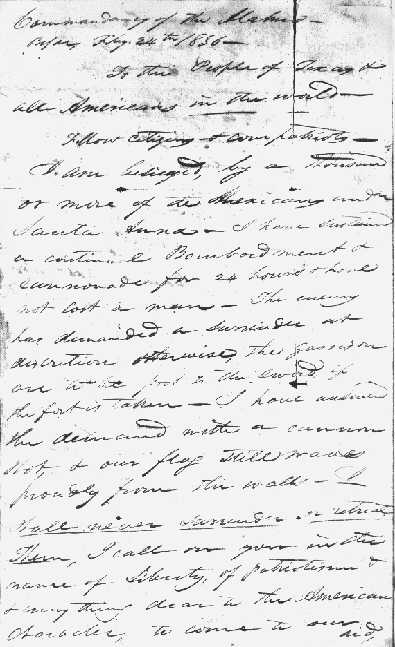
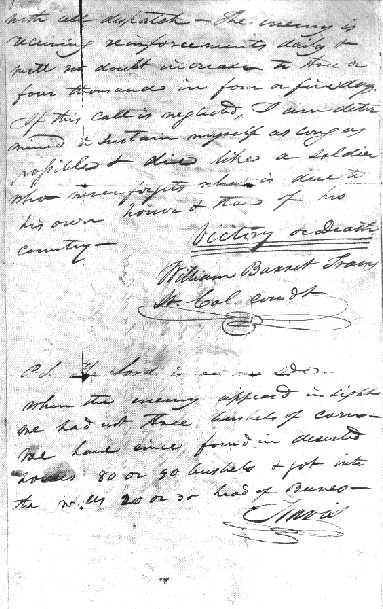
This is the letter that Colonel William B. Travis wrote as the Mexican Army was growing in numbers by the day. This letter is
perhaps the most famous handwritten manuscript in the history of Texas. facing certain death, Travis and his men held the Alamo for another eleven days, thus allowing troops in other parts of Texas to organize and ready themselves to fight for their God-given rights of Freedom and Liberty.
The siege of the Alamo entered its second day on February 24, 1836. James Bowie had fallen ill and confined himself to a room on the south side of the Alamo, leaving full command of the mission to Colonel William B. Travis. Seeing the enemy's 5000 troops against less than 200 of his own men, Travis sent out a desparate plea for reenforcements. His letter became one of the most famous manuscripts in the history of our country.
Colonel Travis wrote:
Commandancy of the Alamo
Bexar, Fby. 24th, 1836
To the People of Texas &
all Americans in the world
Fellow Citizens & Compatriots
I am besieged by a thousand
or more of the Mexicans under
Santa Anna. I have sustained a
continual bombardment &
cannonade for 24 hours & have
not lost a man. The enemy
has demanded a surrender at
discretion, otherwise the garrison
are to be put to the sword if
the fort is taken. I have answered
the demand with a cannon
shot, and our flag still waves
proudly from the walls. I
shall never surrender nor retreat.
Then, I call on you in the
name of Liberty, of patriotism, &
of everything dear to the American
character, to come to our aid
with all dispatch. The enemy is
receiving reinforcements daily &
will no doubt increase to three or
four thousand in four or five days.
If this call is neglected, I am deter-
mined to sustain myself as long as
possible & die like a soldier
who never forgets what is due to
his own honor & that of his
country. Victory or Death
William Barret Travis
Lt. Col. Comdt.
P. S. The Lord is on our side.
When the enemy appeared in sight
we had not three bushels of corn.
We have since found in deserted
houses 80 or 90 bushels & got into
the walls 20 or 30 head of Beeves.
Travis
(Colonel Travis' letter copied from here)
Once again we quote from Wikipedia as they detail further goings on on February 24, 1836, "Travis sent the letter with courier Albert Martin, who delivered it to Gonzales.[48] There, Launcelot Smithers took custody of the message and delivered it to San Felipe,[49] where it was read by Governor Henry Smith. Smith told the colonists at San Felipe "to fly to the aid of your besieged countrymen and not permit them to be massacred by a mercenary foe. ... The call is upon ALL who are able to bear army, to rally without one moment's delay, or in fifteen days the heart of Texas will be the seat of war."[50] The letter was eventually reprinted throughout the United States and much of Europe.[44]
In early evening Mexican Colonel Juan Bringas led scouts across a footbridge over the San Antonio River; Texian sharpshooters quickly killed one soldier and the Mexicans retreated, but Davy Crockett managed to drop a second man before the enemy finally reached cover.[44] Throughout the night the Mexican artillery sporadically bombarded the church and long barracks, while the Mexican army fired muskets and shouted to fool the Texians into believing that an assault was imminent, or that Texian reinforcements were being slaughtered.[51] Santa Anna also ordered that his military band serenade the Texians throughout the night. Mexican soldiers took advantage of the darkness and the distractions of the countrymen to erect two more artillery batteries around the Alamo.[44] The two batteries combined to hold two 8-lb cannon, two 6-lb cannon, two 4-lb cannon, and two 7-in howitzers. One of the batteries was located along the right bank of the San Antonio River, approximately 1,000 feet (300 m) from the south wall of the Alamo. The other was located 1,000 feet (300 m) east of the eastern wall.[52] By the end of the first full day of siege the Mexican army had been reinforced by 600 of Sesma's troops.[53] Gaona and the First Brigade were still several days march away, while an additional 400–500 men and most of the Mexican artillery were struggling through mud south of Bexar."
Reading Colonel Travis' letter and knowing the strength of the Mexican Army was growing by the day, one can almost sense the desperation of the moment. Yet Travis and his men remained defiant in the face of the astronomical odds against them. For these brave souls, staring Death in the face every moment of every day must have been like living in Hell. However, these men knew that the cause they were willing to die for was much bigger than themselves. They would not die in vain. They died for Freedom and Liberty. They died for Texas, God rest their souls and God bless Texas.
Wednesday, February 23, 2011
The Battle of the Alamo
 |
| The Shrine of Texas Liberty |
We begin with this from Wikipedia : "In the early hours of February 23, residents began fleeing Béxar, fearing the Mexican army's imminent arrival. Although unconvinced by the reports, Travis stationed a soldier in the San Fernando church bell tower—the highest location in town—to watch for signs of an approaching force.[22] Travis then sent Captain Philip Dimitt and Lieutenant Benjamin Noble to scout for the Mexican Army's location.[24] At approximately 2:30 that afternoon[24] the church bell began to ring; the soldier stationed in the tower claimed to have seen flashes in the distance.[22] Dimitt and Noble had not returned, so Travis sent Dr. James Sutherland[Note 3] and John W. Smith on horseback to scout the area.[22][24] Smith and Sutherland spotted members of the Mexican cavalry within 1.5 miles (2.4 km) of the town and returned to Béxar at a run."
Wikipedia continues with the story.
Thealamo.org sums it up very nicely with these words:"People worldwide continue to remember the Alamo as a heroic struggle against impossible odds — a place where men made the ultimate sacrifice for freedom. For this reason, the Alamo remains hallowed ground and the Shrine of Texas Liberty."
I can add only six words to all that you've read in this post. Remember the Alamo! God bless Texas!
Tuesday, February 22, 2011
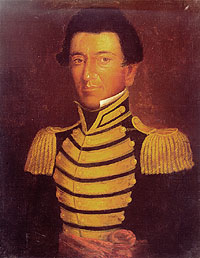
Texas Tidbits: Juan Seguin - Man of Courage
 |
| A Hero in Any Language |
One of the more notable Texas-born Mexican of the Texas Revolution was Juan Seguin. Seguin's is a very interesting story. We begin the story of Juan Seguin as he had just arrived at the Alamo with a band of Texas-born Mexicans to assist Colonel Travis in defend the mission. his stay would be a short one, "Captain Juan N. Seguin, son of Don Erasmo Seguin, organized a company of Texas-born Mexicans to aid in the defense of the Alamo. The native population of San Antonio repeatedly warned Col. Travis to retreat, warning him that he was certain to be overwhelmed, but evidently his hope of receiving aid from other sources caused him to remain. Seguin's men not only assisted in the storming of Bexar, in the preceding December, but some were then serving as scouts for Houston's army at González. Seven of this company fell at the Alamo; namely: Juan Abanillo, Gregorio Esparza, Antonio Fuentes, Toribio Losoya, Andres Nava and Juan Antonio Padilla, all natives of San Antonio, and José Maria Guerrero called "El Tuerto," from Laredo....." Please continue to read about Juan Seguin's service to Texas during the Revolution here at the library at Texas A&M. It's an amazing look at a man who played a pivotal part in the Texan victory over General Santa Anna.
I salute the brave men of Mexican ancestry whose dream of being free men and their willingness to fight and, in many cases, die for Texas' Independence is a legacy not forgotten by the people of Texas nearly 200 years later. I offer to these men a simple prayer...Vayan con Dios, mis amigos. Vayan con Dios. En el Nombre del Padre, el hijo y el Espirito Santo. Amen.
Monday, February 21, 2011
Texas Tidbits: Susanna Dickinson, Alamo Survivor
 |
| Oh, Susanna! |
According to Wikipedia;
Susanna Dickinson reported, after the battle, the following had occurred during the siege and ultimate fight;
- There were very few casualties before the final assault. She did not know the number.
- She confirms that the legendary "line in the sand" incident, where Col. William Travis gave the defenders the choice of staying or leaving, did happen. However, she reports that it happened the day before the final assault, when it is believed to have happened on either March 3 or March 4.
- On the morning of the assault, her husband ran in to where she'd hidden, made his final statements to her and revealing that the Mexicans were inside, then returned to his duty. She never saw him again, nor did she ever see his body.
- She hid inside the chapel, and did not see the actual battle. One defender ran inside during the battle, attempting to hide, but was killed by Mexican soldiers.
- When she was discovered, a Mexican officer intervened, with her saying she believed he was a British mercenary named either Black or Almonte. She was mistaken about his ethnicity, as he was Col. Juan Nepomuceno Almonte, who spoke perfect English, having been educated in New Orleans, Louisiana.
- Outside there was a single survivor, found hiding, who unsuccessfully begged for mercy and was killed. Joe also reported this, claiming the man's name was Warner. However no Warner is listed as being at the Alamo. The closest name in similarity to Warner is Henry Warnell, however Warnell departed the Alamo as a courier on February 28, 1836.
- She saw the body of Davy Crockett between the chapel and the barracks building.
- She saw the body of Jim Bowie with two dead Mexican soldiers lying beside him.
- She was taken to a house where she'd previously lived, and from there could see the pyres of the dead being burned.
- The next day she was taken before Santa Anna, and Almonte, or Black, convinced Santa Anna to release her rather than imprison her.
- She was sent east with Joe, and on the way to Gonzales, Texas she was intercepted by a party including Deaf Smith.
- At some point after the battle, she has no recollections, only that she wept for days.
What a story Susanna Dickinson had to tell. You can read more on her Wikipedia page. I wish I had more time and space to dedicate to Mrs. Dickinson's incredible story. Perhaps we can re-visit this story again in the future. It really fascinates me with what the few survivors of the Battle of the Alamo had to say about what they saw and heard during those historic thirteen days in 1836.
God bless Susanna Dickinson and may God continue to bless Texas.
Friday, February 18, 2011
Texas Tidbits: The Story of Joe the Slave at the Alamo
 |
| Earliest Known Image of the Alamo |
Here's an excerpt from The Handbook of Texas Online : "Joe claimed that when Gen. Antonio López deSanta Annaqv's troops stormed the Alamo on March 6, 1836, he armed himself and followed Travis from his quarters into the battle, fired his gun, then retreated into a building from which he fired several more times. After the battle, Mexican troops searched the buildings within the Alamo and called for any blacks to reveal themselves. Joe did so and was struck by a pistol shot and bayonet thrust before a Mexican captain intervened. Sam, James Bowie's slave, was also reported to have survived the battle, but no further record of him is known to exist. Joe was taken into Bexar, where he was detained. He observed a grand review of the Mexican army before being interrogated by Santa Anna about Texas and its army. Accounts of his departure from the Alamo differ, but he later joined Susanna W. Dickinson and her escort, Ben, Santa Anna's black cook, on their way to Gen. Sam Houston's camp at Gonzales."
Joe was also the only living witness to the famous story about Colonel Travis drawing a line in the sand of the coutryard of the Alamo. The story goes that Travis drew a line in he sand and told his men that bthey could stay and almost certainly perish defending the Alamo or leave without losing their honor. Every last soldier corssed that line and sacrificed his life for the cause of Idependence for Texas. Except for one. He crossed the line to fight along side the orher men, but soo sneaked out if the Alamo before the fight began. He was a French guy. Go figger. Joe the slave told that story to a gathering of the Cabinet of thr new Republic of Texas and was commended for honesty and integrtiy.
Another excerpt from The Handbook of Texas Online gives this account of what later became of Joe: "he remained until April 21, the first anniversary of the battle of San Jacinto. On that day, accompanied by an unidentified Mexican man and taking two fully equipped horses with him, he escaped. A notice offering fifty dollars for his return was published by the executor of Travis's estate in the Telegraph and Texas Register
on May 26, 1837. Presumably Joe's escape was successful, for the notice ran three months before it was discontinued on August 26, 1837. Joe was last reported in Austin in 1875"
I look back at this story and think what a shame it was that Joe did not the opportunity to tell his story to the people of Texas in a book. He was, after all, there when the Alamo fell, and his recollections of that March day in 1836 would have added to the Historical Record, so that future generations would forever more be able to read a first hand account of those thirteen days that stand as one of the greatest stories ever told. Alas, it was not to be.
God bless Joe and may God continue to bless Texas.
Wednesday, February 16, 2011
A Grown Man Recalls a Childhood Incident in the Texas Revolution
 |
| Refuge |
Henry B. Andrews was a small boy at that time all this was going on. Over forty years later, he wrote this letter to woman whose father was killed in service to the cause of freedom for Texas and its people. The letter:
Miss. Maggie Falvel ζ
Galveston ζ
In answer to your letter
of the 25. Last. I can cheerfully testify
to the fact that your father Capt. Luke
Falvel was in the service of the Republic
of Texas. I remember distinctly when
President David G. Burnet ordered your father
who was in command of the Schr. Flash
to remove all the women and children from
New Washington to Galveston which he did.
I was but a boy at the time and was
on the vessel myself, with President Burnet
and others. - I think there should
be no doubt about your mother obtaining
the Land, and I shall be glad to be
of any service in my power to aid her
in doing so.
Respectfully,
H. B. Andrews
It never ceases to amaze me what the people of that time in Texas History would do in order to help others who had family members who gave their lives so that Texas could be free. They were, without question, forged of a hotter fire.
Saturday, February 12, 2011
Texas Tidbits: The Texas Revolution - The Week in Review
 |
| A Challenge to a Tyrant |
Texas History, October, 1835 to March,1836
- The First Shot of the Texas Revolution - The citizens of Gonzales had a big cannon. The Mexican Army wanted it. The people of Gonzales made a flag with a very clear message - "Come and Take It." The Mexicans did not get the cannon.
- Closing in on Independence - This post covers February, 1836. The siege of the Alamo was underway and Texans were bracing for a full blown revolution.
- The Texas Revolution, March, 1836 - Texans declare their Independence from Mexico, the Alamo falls yet the people of Texas are mere weeks away from Freedom and Liberty.
- A Letter of Defiance and Anger - Benjamin Briggs Goodrich wrote a letter to his family in Tennessee to report the death of his brother at the Alamo. He also updates them on the ever-changing events of the Texas Revolution. It's amazing to read it just like you reading your morning newspaper.
God bless you and may God continue to bless that Beautiful Lady we call Texas,
Friday, February 11, 2011
Texas Tidbits: A Letter of Defiance and Anger
 |
| Monument to Liberty |
I am going to reprint the letter in its entirety. It comes to us from thealamo.org.
Benjamin Briggs Goodrich
Little attention has been given to how the news of the Alamo's fall was spread from Texas to the United States. The close family ties and community relationships bound the Texans to their former homes. In this letter, Benjamin Briggs Goodrich, who was a member of the Convention meeting as Washinting-on-the-Brazo, informed his family of death of John C. Goodrich--his brother--on March 6, 1836.1Washington Texas, 15th March, 1836
Dear Edmund,
Texas is in mourning, and it becomes my painful duty to inform my relations in Tennessee of the massacre of my poor brother John. He was murdered in the Texas fortress of San Antonio de Bexar (known as the Alamo) on the night of the 6th of this month, together with one hundred and eighty of our brave countrymen, gallantly defending that place against an invading army of Mexicans, eight thousand strong; not one escaped to tell the dreadful tale. The Alamo had been surrounded for many days by a besieging army of the Mexicans, variously estimated at from 3 to 8 thousand men,2 commanded by Genl. Lopez de Santa Anna in person; the fortress, as before stated, was besieged, and it fell and every man was put to the sword. They effected their purpose by a general charge aided by scaling ladders. Upwards of five hundred of the enemy were killed, and as many more mortally or dangerously wounded. Col. Travis, the commander of the fortress, sooner than fall into the hands of the enemy, stabbed himself to the heart and instantly died.
Seven of our brave men, being all that were left alive, called for quarter and to see Santa Anna, but were instantly shot by the order of that fiendish tyrant. Col. Bowie was murdered, sick in bed.3 Amoung the number of your acquaintances, murdered in the Alamo, were Col. David Crockett, Micajah Autry, formerly of Haysborough, John Hays, son of Andrew Hays of Nashville, and my unfortunate brother, John C. Goodrich: but they died like men, and posterity will do them justice. Santa Anna is now in Texas with an invading army of eight or ten thousand men strong--determined to carry on a war of extermination. We will meet him and teach the unprincipled scoundrel that freemen can never be conquered by the hirling soldierly of a military despot.4
The struggle is great and our difficulties many--but the army of the patriot is doubly served, when his fireside and his liberties are invaded-- We rush to the combat, and our motto is Revenge, Liberty or Death. Approach poor old mother cautiously with this awful news, for I fear her much worn out constitution will not survive the shock. -Publish this information if you think proper--We ask for help and in the name of everything that is sacred to Liberty and Independence.
So soon as the Convention (of which I am a member) adjourns, I shall proceed forthwith to the army.-- The blood of a Goodrich has already crimsoned the soil of Texas and another victim shall be added to the list or I see Texas free and Independent.-- Give my love to my dear mother, sisters and brothers, and friends generally--
Benj. Briggs Goodrich
P.S. News has just reached that the enemy are on the march to this place and we know not at what moment we shall be compelled to move our women and children beyond their reach. Their mode of warfare is strictly savage; they fight under a Red Banner,5 and we ask nor expect no quarter in the future,--I will advise you from time to time (if alive) and would highly appreciate hearing from you.-- Direct your letters to Cantonment Jessup, pay postage and I will be sure to get them.
Sincerely your brother
& relative
Goodrich
[Addressed:]
Free to the U. States, 1836
B. B. Goodrich
Memb. Convention
Mr. Edmund Goodrich
Nashville
Tennessee
The anger and defiance in this letter are palpable. The eloquence visible and the determination of the people of Texas unmistakable. The defiance, determination and anger of the citizens of Texas would be well served in a few short weeks after the time this letter was written by Mr. Goodrich, with a swift and decisive Victory at San Jacinto. It was men like those who perished at the Alamo and the men who took up their cause at San Jacinto that are proof that Texans are indeed forged of a hotter fire.
Subscribe to:
Posts (Atom)