Showing posts with label Sam Houston. Show all posts

Thursday, April 21, 2011

Texas Tidbits: 175th Anniversary of Texas Independence!

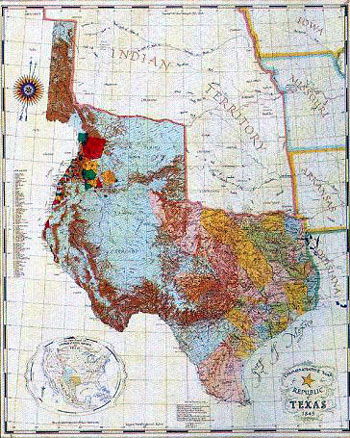
Republic of Texas, 1836
April 21 is one of the most important dates in Texas History. Period. 175 years ago today, The Republic of Texas was born when General Sam Houston and his men routed the mighty Mexican Army in just eighteen minutes with an attack that caught the Mexicans by surprise, confused and in disarray. Gunfire and shouts of "Remember the Alamo" filled the air as the Texians took revenge on the very Army that had made its way across Texas with little or no resistance, save for the Battle of the Alamo, which afforded much-needed time for the Texian Army to regroup. In less time than it takes to cook frozen french fries in the oven, Texas became an Independent Nation.

The San Jacinto Museum website has a brief summary of the Battle of San Jacinto. It begins "In March of 1836, things were not going well for Sam Houston’s Texas revolutionaries. Having declared independence from the official Mexican government, they were now running from the Mexican army, being run from their homes—and running out of time.
Since January 1836, Texas settlers had been abandoning their homes and the lives they’d created on the Texas frontier. Known as the Runaway Scrape, this retreat began as the Mexican government initiated military reoccupation of the newly settled land. The event was marked by sickness, freezing weather, hunger and panic among the citizenry." The rest of the article about this improbable victory can be read here.

When the smoke cleared after the battle, the Mexican Army had lost 600 men, another 700 surrendered and the "Napoleon of the West", Mexican General Santa Anna was found hiding in the brush near the battlefield dressed as a common foot soldier, Sam Houston had been shot in the ankle and the Republic of Texas had become a reality. Further, Mexico had lost "nearly a million square miles in territory. For the Texans, their victory led to annexation into the United States and the United States' war with Mexico. In the end, the United States would gain not only Texas but also New Mexico, Nevada, Arizona, California, Utah and parts of Oklahoma, Kansas, Colorado and Wyoming. As a result of the Battle of San Jacinto, almost a third of what is now the United States of America changed ownership."

The legacy of the people of Texas in 1836is a state that stands as an example not only to the citizens of the United States, but to people around the world, of what a fierce pride in your land and a dogged determination can do for them, when they stand up to tyranny with the singleminded goal of Freedom as the driving force in overcoming seemingly insurmountable odds against the most vicious of oppressors. Like the great football coach Bum Phillips learned at the foot of his Daddy's buddy Bill, "Texans are forged of a hotter fire." Read the story at the previous link if you aren't a Texan, it'll give you a better understanding of how we feel and why we think and act like we do. It's not a bad idea for Texans to give it another look as well. It's dead solid perfect. You'll thank me later.

Go ahead and have a Texas-size hoot today celebrating this defining moment in history. Have some Mexican food, a tall cold beverage and sing with your chest swollen with pride and a tear in your eye "The Eyes of Texas" (sorry about that, Aggies) Enjoy the fellowship with the folks next to you, your fellow Texans. They are, after all, people forged of a hotter fire.

God Bless Texas!


Saturday, March 5, 2011

Texas Tidbits: The Alamo, Victory or Death

We have come to an important moment in the Texas Revolution. The end of the siege of the Alamo is at hand. In less than twenty-four hours, there would be no defenders of the Alamo left alive. The sheer numbers of the Mexican troops alone were overwhelming enough. Combined with exhaustion from very little sleep, mental exhaustion, lack of supplies, etc. and the Texians were no match for much more powerful Mexican forces.

Over the last few days' worth of posts, one could almost feel the tension of the men at the Alamo, as they bravely awaited their fate at the hands of the Mexican Army. As Colonel William B. Travis had so eloquently written in his letter to the American people, ", I am determined to sustain myself as long as possible & die like a soldier who never forgets what is due to his own honor & that of his country. Victory or Death". 

A recap of this week's posts:
If you get the time to do so, please try to read all those posts back to back. It's a gripping story of a fledgling Nation, seeking Independence from a tyrant who ruled with an iron fist, leaving no man, woman or child with Freedom or Liberty. However, in the breasts of great men like Sam Houston, Davy Crockett, William B. Travis, James Bowie and all Texans, before and since the Revolution, beat hearts that call for, nay demand Freedom and Liberty, as endowed by God Almighty Himself. Quoting Colonel Travis again, "die like a soldier who never forgets what is due to his own honor & that of his country. Victory or Death". The people of Texas would settle for nothing less than that which is due them by Providence, for they were Texans, people forged of a hotter fire. God bless Texas!

Wednesday, February 9, 2011

Texas Tidbits: Closing In On Independence

Independence is Near
At this time of year in 1836, events were rapidly taking place as the climax of the Texas Revolution drew near. On February 1, 1836, elections were held across Texas for a convention to select delegates to an Independence Convention. Preparation for military conflicts were also in full swing, as General Santa Ana's Army continued its march towards San Antonio and the inevitable Battle of the Alamo. Texan and American revolutionaries were arriving at the Alamo in an attempt to defend the mission and the city from the Mexicans. Below, you'll see a timeline of the events of the day (from Wikipedia) leading up to the final stand by the Texans at the Alamo.


January 6
Santa Anna arrives at Saltillo.
January 14
January 19
James Bowie and James Bonham arrive at the Alamo with thirty men.
February 1 Elections are held in settlements across Texas for an independence convention.
February 3
William Travis arrives at the Alamo.
February 8
David Crockett arrives at the Alamo.
February 11
Alamo commander J.C. Neill leaves the Alamo due to a family illness. He appoints Travis commander.
February 13
  • Santa Anna and his army reach the city of Guerrero.
  • Travis and Bowie agree upon joint command of the Alamo's forces.
February 16
Santa Anna crosses the Rio Grande.
February 17
Travis sends out letters pleading for men and supplies.
February 21
Santa Anna arrives at the Medina River.
February 22
February 23
Santa Anna enters San Antonio. The Alamo comes under artillery fire from Mexican troops.
February 24
February 25
Fannin, commander of troops at Goliad, receives Travis' plea for aid.
February 26
James Fannin attempts his relief march to the Alamo but turns back.

I want to stop right there for today and pick it up again tomorrow with some of the other things that were reaching critical mass in the Texas Revolution. Still to come are the fall of the Alamo, the Runaway Scrape and the eighteen minutes that changed the course of history of Texas, Mexico and the United States.

Wednesday, December 29, 2010

Texas History: The Civil War and Beyond

The Lone Star
The Civil War was undoubtedly one of the darkest chapters in the history of the United States. The war's effect on Texas was quite different than its effects on other states in the Confederacy and the Union. While 70,000 Texans served in the Confederate Army and participated in just about every major battle in the conflict, no major battles were fought on Texas soil. The main role of Texas at this time was as a supply state to the Confederacy. Other than manpower, beef, ammo and cotton were the most vital contributions made by the state during the war. When Union troops blockaded Galveston and other Texas ports, cotton was traded with European countries and Mexico for supplies to aid the Confederate Army in its war effort.

While the overwhelming majority of Texans supported secession from the Union, there was significant opposition to such a move, spearheaded by none other than Sam Houston his own self. From Wikipeadia , "Houston was probably the premier "Unionist" in Texas. Like most of the same in the South, he strongly believed in the doctrine of states rights, and even assured his fellow Texans he would personally lead the state out of the Union should matters justify such. However, he thought secession at the moment in time was "rash action," and certain to lead to a conflict sure to favor– in the long run– the industrial and populated North. He predicted: "Let me tell you what is coming. After the sacrifice of countless millions of treasure and hundreds of thousands of lives you may win Southern independence if God be not against you, but I doubt it. The North is determined to preserve this Union. They are not a fiery impulsive people as we are...but once they begin to move in a given direction, they move with the steady momentum of a mighty avalanche, and what I fear is that they will overwhelm the South with ignoble defeat." Houston was clairvoyant with his words.

Texas, of course, rejoined the Union.However, her rise to prominence on the national stage lay ahead of her. She had survived a war for independence, a stint as her own country, Civil War and Yankee Carpetbaggers during Reconstruction, but she would rise to meteoric heights in the future with the same dogged determination and courage her people had displayed during the toughest of times. She is, after all, "the damnedest lady you ever saw". She is Texas. Long may she live!

Saturday, November 27, 2010

Thanksgiving Leftovers and Stuff(ing) UPDATED

UPDATED: Links in the post are now fixed. Sorry about the problems.
Toby

 We made it through Black Friday and are full steam ahead into the Christmas Season. My wife is a Christmas Freak, so at my house we are getting into the Spirit of Christmas at warp speed. Yesterday we did some house cleaning and re-arranging of furniture so we could put up the Christmas tree, which we did. We also have this damn five foot tall snowman that dances and sings when somebody walks close enough to it. The kids and Heather love it. Me? Not so much. It was a gift from my father-in-law, so going postal on the stupid thing is out of the question. So far. I guess I could put some duct tape over the motion sensor on it, but I would have to face The Wrath of the Wife if I did, so scratch one great idea. I bring up Christmas because I am gonna make a concerted effort to post Christmas related material on this blog for the next few weeks. With that, let's have another "Best of..." Weekend of some of the most popular posts from recent weeks. 

  • Texas Tidbits: Big Drunk, A Texas Hero - I did this post about three weeks ago on what ended up being a slow blog day, so I figured I'd give it another go today.
  • Maine Minutiae: Haunted Maine, Seguin Island Lighthouse - The posts I have written about lighthouses have proven to be very popular. here's one I wrote just before Halloween. Read it, if you dare.
  • Colorado Chronicles: Unsinkable - The story of the Unsinkable Molly Brown. This is a pretty good post. Look it over, when you can.
That's a good lineup of some of our most popular posts that merit another look. I hope you enjoy reading them as much as I enjoyed writing them. Here's a quick reminder that if you'd like to write a guest post for Three States Plus One, drop me a note or an article at threestatesplusone AT gmail DOT com and I'll look it over and post for both of my readers to see! Don't be shy. I mean, hell, you've read some the crap Pulitzer-worthy material I've written, so your submission would undoubtedly be much better. Send 'em in and be ridiculed by friends and family alike recognized as a literary giant. Have a safe Saturday and watch out for bargain-hunting vicious little old ladies if you dare to brave the world of Christmas shopping today.

Monday, November 8, 2010

Texas Tidbits: Big Drunk, A Texas Hero and Legend

Texas History is filled with men that are larger-than-life characters. A short list of such people would include James Bowie, Davy Crockett and William B. Travis, defenders of the Alamo, all. There's one man, however, that is, in my opinion, probably the most influential man in the history of Texas. The largest city in the state is named for him, a county is named for him, streets, arenas and schools are named for him. You've guessed by now that I am referring to Sam Houston. Houston was truly larger than life in one regard in that he was 6'6" tall, compared to the average man of the time who was about 5'7". (I'm working off memory here, so I may be off an inch or so for either number).

Houston not only cast a large shadow as a man, but also cast a mighty long shadow as a soldier and politician. He is the only man to ever be Governor of two states, Tennessee from 1827-1829 and, of course, Texas from 1859-1861. He was a Senator from Texas from 1846-1859 and was the first (elected) and the third President of Texas.

He was a veteran of the War of 1812, but Houston's greatest claim to fame, even if he never held elective office, was as the commander of the Texian Army that defeated General Santa Ana at San Jacinto, securing Texas' independence from Mexico and therefore assuring him a prominent place in Texas History. A quick piece of trivia here, Houston was born on March 2, which, as fate would have it, is same date as Texas Independence Day.

Sam Houston was also a great friend of and advocate for the Indians of Arkansas, Tennessee and Texas. At one time he was granted citizenship as member of the Cherokee Nation. Houston was known to partake in an adult beverage or twelve and the Cherokee gave him the nickname of Big Drunk. His close friendship with the Cherokee caused quite a stir in Washington, D.C., especially with Houston's friend and mentor, Andrew Jackson. Here's an excerpt from wikipedia regarding this matter, "In 1830 and again in 1832 Houston visited Washington, DC to expose the frauds which government agents committed against the Cherokee.[5] While he was in Washington in April 1832, anti-Jacksonian Congressman William Stanbery of Ohio made accusations about Houston in a speech on the floor of Congress. Attacking Jackson through his protégé, Stanbery accused Houston of being in league with John Van Fossen and Congressman Robert S. Rose. The three men had bid on supplying rations to the various tribes of Native Americans who were being forcibly relocated because of Jackson's Indian Removal Act of 1830. After Stanbery refused to answer Houston's letters about the accusation, Houston confronted him on Pennsylvania Avenue and beat him with a hickory cane. Stanbery drew one of his pistols and pulled the trigger—the gun misfired. On April 17 Congress ordered Houston's arrest. Pleading self-defense, he hired Francis Scott Key as his lawyer. Houston was found guilty, but thanks to highly placed friends (among them James K. Polk), he was only lightly reprimanded. Stanbery filed charges against Houston in civil court. Judge William Cranch found Houston liable, and fined him $500. Houston left the United States for Mexico, without paying the fine." And with that, Houston packed up his toys and headed for Texas. The rest of the Wikipedia article has some great biographical info on :Big Drunk". When you get a few minutes, it's well worth the read.

Years ago, I read an outstanding book on Sam Houston and I am ashamed to say that I don't remember the title nor the author. I say that in order to point out what a fascinating subject Sam Houston is and just about any book about him would make for some very interesting reading. He was quite a colorful character who was much more than just the man who won the decisive battle for Texas' independence, Sam Houston was a statesman, Governor, Senator and President and by the Grace of God, a Texan.

Thursday, November 4, 2010

Texas Tidbits: The Father of Texas

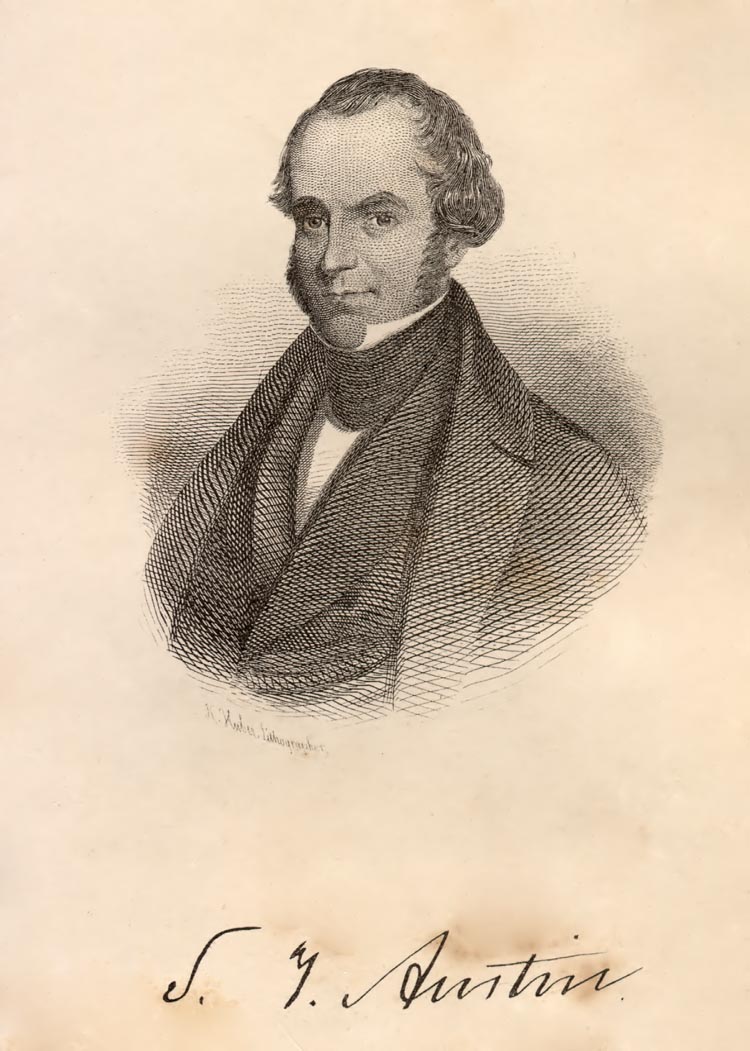
Four and a half months ago when I first started this blog, I wrote a Plus One post about Virginia. I saluted Virginia for some of the great Americans that were born there who went on to do great things for our country. On that day, I left out a man who was a native son of Virginia, and today I could slap a knot on my own head so tall I'd have to tiptoe to scratch it. The man's name? Stephen Fuller Austin. The Father of Texas. I am a dumbass.

I was going to post this yesterday because it was the anniversary of SFA's birth. But the Republican Tsunami was a pretty big deal so I wrote about that instead.

The Father of Texas**
Stephen Fuller Austin was born in Virginia on November 3, 1793. By age twenty one, Austin was a lawyer and a member of the First Circuit Court. During this time, Austin's father, Moses, received an empresarial grant that allowed him to take 300 Americans into Texas. Moses then was traveling back to Missouri when he was attacked and soon contracted pneumonia and died in June, 1821. Upon his death, Moses Austin left his empresarial grant to Stephen. I was a bit surprised to learn that Stephen was, at first, reluctant to carry out his father's dream of colonizing Texas. However, a letter from Ma Austin changed Stephen's mind about it. And thus began the journey of the man who would be the Father of Texas.

During his attempt to bring Americans to Texas, Austin wore a path out to Mexico while dealing with the new Mexican government (Mexico had just won its independence from Spain). The rules regarding his land grant seemed to change by the minute. Undeterred, Austin finally got that mess settled and in late 1825, he brought  300 Americans to Texas. This was the first step in Stephen F. Austin being recognized as The Father of Texas. There's some detailed information on the trials and tribulations Austin had to overcome to colonize Texas with American settlers here.

In 1836, when Texas had won its independence from Mexico, Austin threw his name into the hat to be a candidate for the Presidency of the new Republic of Texas. He was the odds on favorite to win the election, but someone else had eyes on that prize. His name was Sam Houston. After his victory at San Jacinto establishing Texas' new status as a sovereign country, Houston won the election in a landslide. Upon taking on his role as President of Texas, Houston named Austin as his Secretary of State, a post he held for only two months. Stephen F. Austin contracted what he thought was a bad cold, but it was actually pneumonia. He died on December 27, 1836. Austin's last words were, "The Independence of Texas is recognized! Don't you see it in the papers!". After learning of Austin's death, President Sam Houston issued this statement, "The Father of Texas is no more. The first pioneer of the wilderness has departed." Austin is gone, Mr. President, but he will for eternity be known as The Father of Texas and his name will be revered by Texans forevermore.

**Image from sonofthesouth.net

Copyright ©

All Original Material © Toby Shoemaker