Showing posts with label William B. Travis. Show all posts

Thursday, March 3, 2011

Texas Tidbits: The Defenders of the Alamo Know Their Destiny Awaits Them, Day 10

Destiny
It's now March 3, 1836. Texas had declared her independence from Mexico and the defenders of the Alamo are watching as the Mexican Army under the command of General Santa Anna was steadily growing in numbers. 1000 more men had joined Santa Anna bringing the total number of troops ready to attack the Alamo to about 2400 men. The Texians inside the mission must have demoralized by such a sight. As Colonel Travis wrote in a letter sent to the Constitutional Convention at Washington-on-the-Brazos, "Travis sent a courier that evening to the Convention with news that the Texians had thus far survived the siege with no losses. He warned, however, that: "I look to the colonies alone for aid; unless it arrives soon, I shall have to fight the enemy on his own terms. I will, however, do the best I can under the circumstances, and I feel confident that the determined valour and desperate courage, heretofore evinced by my men, will not fail them in the last struggle, and although they may be sacrificed to the vengeance of a Gothic enemy, the victory will cost the enemy so dear, that it will be worse for him than a defeat." Travis' words were eerily prophetic. He and his men had to know that they were sitting ducks, but still they displayed heroic resolve and courage in the face of astronomical odds. In three days their legacy would be legendary.

Wikipedia has more, " The reinforcements brought the number of Mexican soldiers in Bexar to almost 2,400.[118]During the day, the Mexican army had erected a battery on the north side of the Alamo, within musket shot of the complex walls.[111] Unlike previous bombardments, each shot from this battery impacted the walls, causing them to begin to crumble. By nightfall, part of the wall had begun to collapse, and Jameson kept the men working all night to shore up the walls with pieces of lumber.[119]Almonte's journal reported that there was an engagement after dark on March 3, but that the Mexican troops had repulsed the assault.[120] Several historians, including Walter Lord, speculated that the Texians were creating a diversion to allow Smith to escape.[121] However, in 1876, Susannah Dickinson said that Travis sent three men out shortly after dark on March 3, probably in response to the arrival of the Mexican reinforcements. The three men, who Dickinson believed included Davy Crockett, were sent to find Fannin.[122] Lindley stated that just before midnight, Crockett and one of the other men found the force of Texians waiting along Cibolo Creek, who had advanced to within 20 miles (32 km) of the Alamo. Just before daylight on March 4, part of the Texian force managed to break through the Mexican lines and enter the Alamo. A second group was driven across the prairie by Mexican soldiers.[123] Lindley based his assumptions on two newspaper reports published within a month of the Alamo's fall that stated that 50 men had reinforced the Alamo a few days before the final assault."

I don't know about you, but I can almost feel what is going on at the Alamo as we go through the history of this battle. It is truly an extraordinary story - heroes facing certain death at the hands of a brutal man in Santa Anna, only to be avenged a few weeks later in a battle that would free Texas of Mexican rule. God bless those brave men. And may God continue to bless Texas.


Monday, February 28, 2011

Texas Tidbits: Time Is Not an Ally to Travis and His Men, The Siege of the Alamo, Days 6 - 9

***Quick note: So I don't confuse you with the number of days until a certain event, etc., 1836 was a Leap Year, so that's why it seems like there's an extra day, because there was!  :)***

Remembering Gonzales on the Way to the Alamo
The next four days in the Siege of the Alamo were fairly uneventful as far as the two sides shooting at each other, but there was quite a bit going on away from the Alamo, as Texians from various locations planned to rush to the besieged mission and serve as reinforcements to Colonel Travis command. Dodging roving Mexican troops was a constant problem for the reinforcements, even causing some of the men headed for the Alamo to become separated from their larger group. At this point, we turn to ever useful Wikipedia: "After learning that Fannin was not coming and that there would likely be no other reinforcements,[77] a group of 25 men set out from Gonzales at 2 pm on Saturday, February 27.[96] They were led by Martin and George Kimbell, Almaron Dickinson's business partner.[97] As the group passed the ranch of volunteer John G. King on their way out of town his fifteen-year-old son, Wiliam, rushed out and asked to take his father's place, as John King was needed to support the family's nine children. The men agreed, and William exchanged places with his father.[98] On the march to Bexar eight additional men joined the group.[99] The men carried with them the first flag ever made for use in a Texian battle; the Come and take it flag from the Battle of Gonzales." There's more to this story and you can read it at Wikipedia.

Time was not a trusty ally to the Defenders of the Alamo, nor to the men who would be much-needed firepower to the weary men at the mission, for within a week's time, they would all perish pursuing those most-cherished of God-given rights, the Twin Sisters of Liberty and Freedom.

God bless Texas!

Sunday, February 27, 2011

Texas History: The Battle of the Alamo- The First Five Days

Brave men, one and all
We have covered quite a bit of territory since we began chronicling The Battle of the Alamo earlier this week. One of the more surprising things that I personally learned was that for the first few days of the battle, the local citizenry was allowed to come and go in and out of the Alamo almost at will. As a matter of fact, Juan Seguin had his dinners delivered to him by one of the locals! All in all, it was a fairly quiet week as far as warfare goes, but you can sense what is about to happen, and it ain't good for the "Home Team".

Some of the posts are a bit long, but they are well worth the time it takes to read them.The week in review:
As I read more and more of the Texians' epic struggle for Freedom, the deeper I find that mentally I am immersing myself deep and deeper into this historic conflict. It's almost like a movie of the day by day events playing inside my head. Like a fly on the wall, I can see everything unfolding in front of me - the Texians fortifying there position inside the mission, while on the Mexican side, General Santa Anna maneuvers his men into just the right formation for the massive attack on the Alamo that is a mere few days away. I can plainly see Colonel William B. Travis, hastily and with great emotion penning his famous plea for more men and supplies at the Alamo (the letter is in the "Day 2" post above).


I hope you enjoy reading or re-reading the history of the first five days of the siege of the Alamo as much as I liked researching and writing them. Grab a cup of coffee, sit back and read away!

Saturday, February 26, 2011

Texas Tidbits: The Siege of the Alamo, Days 4 & 5

The End is Near
The Siege of the Alamo was now entering its fourth day. Colonel Travis' urgent appeals for help were still unanswered, while the number of men underthe command of General Santa Anna was growing almost daily. The first three days of the siege were mostly uneventful, however the battle yet to come was building to a crescendo. It would be a mere five days more and the Battle of the Alamo would be one of the most famous military engagements in the history of mankind. Several hundred Mexican troops and every defender of the Alamo would lay dead.

In what seems a bit odd, the townspeople of Bexar were allowed to come and go near or into Alamo. Juan Seguin even had his meals made and brought to him while holed up in the Alamo. The Mexican Army had lobbed a couple of hundred cannon shots into the coutryard of the Alamo and the Texians would retrieve them and then later use them against the Mexicans. This is stuff I never had neard of before today. I mean here we are in the middle of arguably the most famous military skirmishes ever and people were coming and going into the battle zone as they saw fit! Things would soon get serious. Dead serious. Wikipedia picks up the story from here:
Although the Texians had matched Mexican artillery fire, on February 26, Travis ordered the artillery to stop firing to conserve powder and shot. Crockett and his men were encouraged to keep shooting, as they rarely missed and thus didn't waste shot.[72] Through the early days of the siege, the Texians didn't bother to take cover, as the Mexicans were too far out of their range to cause harm with their muskets; any Mexican soldier who ventured within 200 yards (180 m) of the Alamo, however, risked death or injury.[73] A blue norther blew in that evening and dropped the temperature to 39 degrees F.[72] Neither army was prepared for the cold temperatures.[59] Several Texians ventured out to gather firewood but returned empty-handed after encountering Mexican skirmishers.[72] On the evening of February 26, the Texians burned more huts, these located near the San Luis Potosi Battalion.[62] Santa Anna sent Colonel Juan Bringas to engage the Texians, and according to Edmondson, one Texian was killed.[74] On February 26, news of the siege finally reached acting governor James W. Robinson, who immediately sent a courier to find Sam Houston.[75] Travis's messengers were having small successes. Albert Martin had reached Gonzales, the most westerly community of Texians, on February 25, the day after Sutherland and Smith had arrived with Travis's first message.[72][76] As couriers delivered the messages to other settlements, reinforcements assembled in Gonzales, waiting for Fannin to arrive with more troops so they could travel together.[77] In Gonzales itself, Robert "Three-Legged Willie" Williamson began a recruitment drive.[78] In Bastrop, Edward Burleson began organizing a militia, which likely left for Gonzales on February 27,[79] arriving the following day.[80]
Unbeknownst to the Texians, Colonel James Fannin had finally decided to ride to their relief.[81] Historian Robert Scott suggests that the trip was initiated after Fannin's objections were overridden by his officers.[82] On the morning of February 26, he set out with 320 men, 4 cannon, and several supply wagons for the 90 miles (140 km) march from Goliad to the Alamo.[81] The Goliad garrison had no horses to move the wagons and artillery and were forced to rely on oxen.[62] Barely 200 yards (180 m) into their journey, one of the wagons broke down, and the expedition stopped for repairs.[81] The group then took six hours to cross the waist-deep water of the San Antonio River. By the time they reached the other side it was dark, and the men camped along the river. The cold front reached Goliad that evening, and the poorly-dressed soldiers were "quickly chilled and miserable" in the driving rain.[83] On awakening, Fannin realized that all of the Texian oxen had wandered off, and that his men had neglected to pack food for the journey.[84] It took most of the day for the men to round up the oxen; after two days of travel, Fannin's men had not even ventured 1 mile (1.6 km) from their fort.[85] In a letter to Acting Governor James Robinson, Fannin said that his officers approached him to ask that the rescue trip be cancelled, as they had received word that General Urrea's army was marching towards Goliad.[83] The officers and men in the expedition claimed that Fannin decided on his own to abort the mission. Several of the men agreed with the decision, with Dr. Barnard writing in his journal, "With but three or four hundred men, mostly on foot, with but a limited supply of provisions, to march a distance of nearly one-hundred miles through uninhabited country for the purpose of relieving a fortress beleaguered by five-thousand men was madness!"[86]
Before initially leaving Goliad, Fannin sent a courier to Gonzales to instruct Williamson to rendezvous at Cibolo Creek, halfway between Gonzales and Goliad.[78] On February 28, about 60 men, including Captain Albert Martin, travelled the 20 miles (32 km) from Gonzales to Cibolo Creek to wait for Fannin and his men.[80][87] Lindley speculates that Fannin sent an advance relief for under Captain John Chenoweth and Francis de Sauque to scout the area around Bexar. The advance force reached as far as the Seguin ranch, gathering corn, cattle, horses, and mules, then turned back to wait along Cibolo Creek for the remainder of Fannin's force.[78][88]
Several residents had seen Fannin march from Goliad and sent messengers to Bexar to inform Santa Anna that Fannin and 300 men were headed for the Alamo. Santa Anna ordered Colonel Juan Almonte and 800 dragoons to intercept the Texian relief force.[89] Unaware of Fannin's aborted relief mission, Travis sent James Bonham to Goliad to persuade him.[90] Bonham was asked to tie a white handkerchief around his hat when he returned so that the Texians would know to open the gates for him.[91]
Much of the Mexican army's provisions were in the rear of the convoy with Gaona and Filisola. Santa Anna had hoped to restock his army's supplies in Bexar, but were unable to find much.[92] He finally asked a local citizen, Manuel Menchaca, to help them find food; Menchaca led the army to the Seguin and Florez ranches and liberated all of their corn, beef, and hogs.[93] Santa Anna sent more couriers to Gaona and Filisola to urge them to hury; Filisola was still at the Rio Grande.[92]
During the day the Mexican army tried to block the irrigation ditch leading into the Alamo. Texian Green Jameson tasked the men in the Alamo with finishing a well at the south end of the plaza. Although the men hit water, they weakened an earth and timber parapet by the low barracks; the mound collapsed, leaving no way to fire safely over that wall.[94] The same day Texians spotted a Mexican general surrounded by aides and dragoons and fired, but did not hit any of them.[73] The Texians did not realize it was Santa Anna.

The Texas Revolution would soon reach a fevered pitch and the fall of the Alamo would be a rally cry for the Texian Army, for the Battle of San Jacinto and Independence for Texas were less than two months away.


Remember the Alamo! And God bless Texas!

Thursday, February 24, 2011

Texas Tidbits: The Siege of the Alamo, Day 2


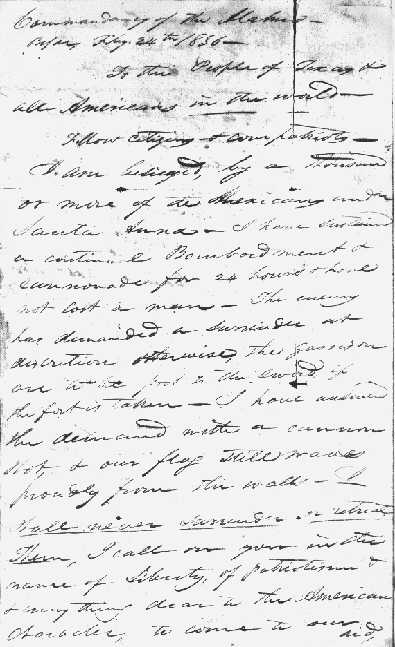
 This is the letter that Colonel William B. Travis wrote as the  Mexican Army was growing in numbers by the day. This letter is
perhaps the most famous handwritten manuscript in the history of Texas. facing certain death, Travis and his men held the Alamo for another eleven days, thus allowing troops in other parts of Texas to organize and ready themselves to fight for their God-given rights of Freedom and Liberty.


The siege of the Alamo entered its second day on February 24, 1836. James Bowie had fallen ill and confined himself to a room on the south side of the Alamo, leaving full command of the mission to Colonel William B. Travis. Seeing the enemy's 5000 troops against less than 200 of his own men, Travis sent out a desparate plea for reenforcements. His letter became one of the most famous manuscripts in the history of our country.

Colonel Travis wrote:


Commandancy of the Alamo
Bexar, Fby. 24th, 1836


To the People of Texas &
all Americans in the world
Fellow Citizens & Compatriots

I am besieged by a thousand
or more of the Mexicans under
Santa Anna. I have sustained a
continual bombardment &
cannonade for 24 hours & have
not lost a man. The enemy
has demanded a surrender at
discretion, otherwise the garrison
are to be put to the sword if
the fort is taken. I have answered
the demand with a cannon
shot, and our flag still waves
proudly from the walls. I
shall never surrender nor retreat.

Then, I call on you in the
name of Liberty, of patriotism, &
of everything dear to the American
character, to come to our aid 

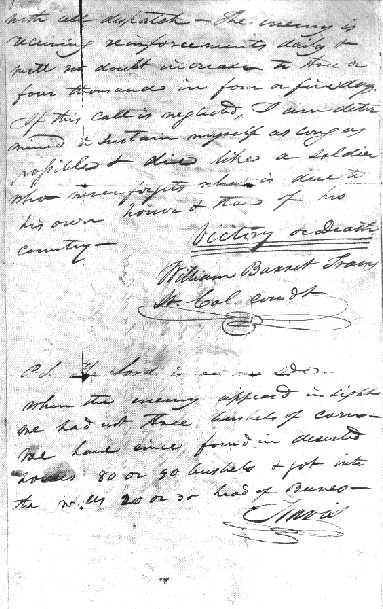
with all dispatch. The enemy is
receiving reinforcements daily &
will no doubt increase to three or
four thousand in four or five days.
If this call is neglected, I am deter-
mined to sustain myself as long as
possible & die like a soldier
who never forgets what is due to
his own honor & that of his
country.
Victory or Death
William Barret Travis
Lt. Col. Comdt.

P. S. The Lord is on our side.
When the enemy appeared in sight
we had not three bushels of corn.
We have since found in deserted
houses 80 or 90 bushels & got into
the walls 20 or 30 head of Beeves.

Travis

(Colonel Travis' letter copied from here)

Once again we quote from Wikipedia as they detail further goings on on February 24, 1836, "Travis sent the letter with courier Albert Martin, who delivered it to Gonzales.[48] There, Launcelot Smithers took custody of the message and delivered it to San Felipe,[49] where it was read by Governor Henry Smith. Smith told the colonists at San Felipe "to fly to the aid of your besieged countrymen and not permit them to be massacred by a mercenary foe. ... The call is upon ALL who are able to bear army, to rally without one moment's delay, or in fifteen days the heart of Texas will be the seat of war."[50] The letter was eventually reprinted throughout the United States and much of Europe.[44]
In early evening Mexican Colonel Juan Bringas led scouts across a footbridge over the San Antonio River; Texian sharpshooters quickly killed one soldier and the Mexicans retreated, but Davy Crockett managed to drop a second man before the enemy finally reached cover.[44] Throughout the night the Mexican artillery sporadically bombarded the church and long barracks, while the Mexican army fired muskets and shouted to fool the Texians into believing that an assault was imminent, or that Texian reinforcements were being slaughtered.[51] Santa Anna also ordered that his military band serenade the Texians throughout the night. Mexican soldiers took advantage of the darkness and the distractions of the countrymen to erect two more artillery batteries around the Alamo.[44] The two batteries combined to hold two 8-lb cannon, two 6-lb cannon, two 4-lb cannon, and two 7-in howitzers. One of the batteries was located along the right bank of the San Antonio River, approximately 1,000 feet (300 m) from the south wall of the Alamo. The other was located 1,000 feet (300 m) east of the eastern wall.[52] By the end of the first full day of siege the Mexican army had been reinforced by 600 of Sesma's troops.[53] Gaona and the First Brigade were still several days march away, while an additional 400–500 men and most of the Mexican artillery were struggling through mud south of Bexar."


 Reading Colonel Travis' letter and knowing the strength of the Mexican Army was growing by the day, one can almost sense the desperation of the moment. Yet Travis and his men remained defiant in the face of the astronomical odds against them. For these brave souls, staring Death in the face every moment of every day must have been like living in Hell. However, these men knew that the cause they were willing to die for was much bigger than themselves. They would not die in vain. They died for Freedom and Liberty. They died for Texas, God rest their souls and God bless Texas.

Wednesday, February 23, 2011

The Battle of the Alamo

The Shrine of Texas Liberty
February 23, 1836 is one of the most important dates in the annals of Texas History. It was on this date 175 years ago that one of the most famous battles ever fought on any land got underway. The Battle of the Alamo had begun. Today, as we recount the events of Febrary 23, 1836, I will forego my usual commentary and allow those who are far more qualified than I to retell the story of the defining moment in Texas History.

We begin with this from Wikipedia : "In the early hours of February 23, residents began fleeing Béxar, fearing the Mexican army's imminent arrival. Although unconvinced by the reports, Travis stationed a soldier in the San Fernando church bell tower—the highest location in town—to watch for signs of an approaching force.[22] Travis then sent Captain Philip Dimitt and Lieutenant Benjamin Noble to scout for the Mexican Army's location.[24] At approximately 2:30 that afternoon[24] the church bell began to ring; the soldier stationed in the tower claimed to have seen flashes in the distance.[22] Dimitt and Noble had not returned, so Travis sent Dr. James Sutherland[Note 3] and John W. Smith on horseback to scout the area.[22][24] Smith and Sutherland spotted members of the Mexican cavalry within 1.5 miles (2.4 km) of the town and returned to Béxar at a run."
Wikipedia continues with the story.

Thealamo.org sums it up very nicely with these words:"People worldwide continue to remember the Alamo as a heroic struggle against impossible odds — a place where men made the ultimate sacrifice for freedom. For this reason, the Alamo remains hallowed ground and the Shrine of Texas Liberty."

I can add only six words to all that you've read in this post. Remember the Alamo! God bless Texas!

Friday, February 18, 2011

Texas Tidbits: The Story of Joe the Slave at the Alamo

Earliest Known Image of the Alamo
While many of us are familiar with the names of the men who died at the Battle of the Alamo, very few of us are familiar with the names of those who survived the attack. yes, there some who made it out alive. One such survivor was a freed slave of William B. Travis, commander of the Alamo. The only name we can find for the slave is Joe. This man was an eyewitness to the happenings of one of the most famous military engagements in history, and he lived to tell about it.

Here's an excerpt from The Handbook of Texas Online : "Joe claimed that when Gen. Antonio López deSanta Annaqv's troops stormed the Alamo on March 6, 1836, he armed himself and followed Travis from his quarters into the battle, fired his gun, then retreated into a building from which he fired several more times. After the battle, Mexican troops searched the buildings within the Alamo and called for any blacks to reveal themselves. Joe did so and was struck by a pistol shot and bayonet thrust before a Mexican captain intervened. Sam, James Bowie's slave, was also reported to have survived the battle, but no further record of him is known to exist. Joe was taken into Bexar, where he was detained. He observed a grand review of the Mexican army before being interrogated by Santa Anna about Texas and its army. Accounts of his departure from the Alamo differ, but he later joined Susanna W. Dickinson and her escort, Ben, Santa Anna's black cook, on their way to Gen. Sam Houston's camp at Gonzales."


Joe was also the only living witness to the famous story about Colonel Travis drawing a line in the sand of the coutryard of the Alamo. The story goes that Travis drew a line in he sand and told his men that bthey could stay and almost certainly perish defending the Alamo or leave without losing their honor. Every last soldier corssed that line and sacrificed his life for the cause of Idependence for Texas. Except for one. He crossed the line to fight along side the orher men, but soo sneaked out if the Alamo before the fight began. He was a French guy. Go figger. Joe the slave told that story to a gathering of the Cabinet of thr new Republic of Texas and was commended for honesty and integrtiy.

Another excerpt from The Handbook of Texas Online gives this account of what later became of Joe: "he remained until April 21, the first anniversary of the battle of San Jacinto. On that day, accompanied by an unidentified Mexican man and taking two fully equipped horses with him, he escaped. A notice offering fifty dollars for his return was published by the executor of Travis's estate in the Telegraph and Texas Register
on May 26, 1837. Presumably Joe's escape was successful, for the notice ran three months before it was discontinued on August 26, 1837. Joe was last reported in Austin in 1875"

I look back at this story and think what a shame it was that Joe did not the opportunity to tell his story to the people of Texas in a book. He was, after all, there when the Alamo fell, and his recollections of that March day in 1836 would have added to the Historical Record, so that future generations would forever more be able to read a first hand account of those thirteen days that stand as one of the greatest stories ever told. Alas, it was not to be.

God bless Joe and may God continue to bless Texas.

Copyright ©

All Original Material © Toby Shoemaker