Friday, February 25, 2011

Texas Tidbits:The Siege of the Alamo, Day 3

Two Star Flag PO'ed the Mexicans(see below)
On February 25, 1836 the Alamo had been under siege by the Mexican Army under the command of Santa Anna. Still under bombardment from the night before, about 10:00am Santa Anna sent some of his men to set up some artillery batteries in some abandoned homes near the Alamo. The defenders quickly recognized what was going on and "Travis called for volunteers to burn the huts, despite the fact that it was broad daylight and they would be within musket range of the Mexican soldiers.[55] Charles Despallier, Robert Brown, James Rose and a few others volunteered for the mission.[57] To provide cover, Dickinson and his men fired their 8-lb cannons, filled with grapeshot and canister, at the Mexican soldiers in the huts. Crockett and his men fired rifles, while other Texians reloaded extra weapons for them. Within two hours the battle was over.[56] As soon as the Texians saw flames erupting from the huts they threw open the Alamo gate, and the Texians re-entered the Alamo, unscathed,[58] although Rose was almost captured by a Mexican officer.[57] The Mexican soldiers retreated,[59] after six of their soldiers were killed and four wounded, while several Texians had been mildly scratched by flying rock.[54]
That afternoon Mexican soldiers were posted east of the Alamo, on the road to Gonzales.[54] Santa Anna learned that a beautiful 17-year-old girl, Melchora Barrera, and her widowed mother had remained in town, and he dispatched one of his men to ask the girl to be Santa Anna's mistress. According to historian J.R. Edmondson, the girl's mother refused the offer, and, although Santa Anna was already married, one of his officers dressed up as a priest and performed a marriage ceremony. Santa Anna then retired to enjoy a honeymoon.[60]Santa Anna sent a messenger to tell Gaona to hurry to Bexar with his three best companies.[61] At the time, the First Brigade was at San Ambrosio, a day's march north of the Rio Grande. According to the diary of Jose Enrique de la Pena, on this day carelessness led the Aldama Battalion's powder supply to catch fire, causing "considerable alarm".[62] Travis also wrote another letter requesting help. The Texian officers voted that Seguin should carry the message.[63] Travis was adamant that Seguin remain behind, as his knowledge of the language, the countryside, and Mexican customs was invaluable.[64] The Texians believed that none of the other couriers had made it through the Mexican lines,[65] and told Travis that Seguin's knowledge of Spanish would also help him to avoid capture by Mexican patrols.[66] Seguin, riding Bowie's horse, which was the fastest in the mission, and his aide Antonio Cruz left about 9 pm.[54] Seguin did not expect to survive the mission; he and Cruz encountered a Mexican cavalry patrol[67] but were able to escape using their knowledge of Spanish and the local terrain.[54]
After dark, a small party of Texians left the Alamo to burn down more of the huts; all were able to return to the Alamo without injury.[68] Despite their efforts, several huts remained standing, and overnight the Mexican army was able to erect a battery only 300 yards (270 m) from the Alamo.[69] An additional battery was erected at a location known as old Powderhouse, 1,000 yards (910 m) to the southeast of the Alamo. The Mexican army now had artillery stationed on three sides of the Alamo.[54] Historian Walter Lord said that in the evening several Mexicans left the Alamo and asked to surrender to Santa Anna; they were told that Santa Anna had retired for the evening and could not be disturbed"

While day three of the conflict was a "good one" for the Texians, their most trying days were still ahead of them, the Ultimate Sacrifice for their country would be the end result.

***The two star flag showed Texas & Coahuila  as separate states. The Mexicans were not amused.***

***The Quoted Text Above and the Two Star Flag are From Wikipedia***

Thursday, February 24, 2011

Texas Tidbits: The Siege of the Alamo, Day 2


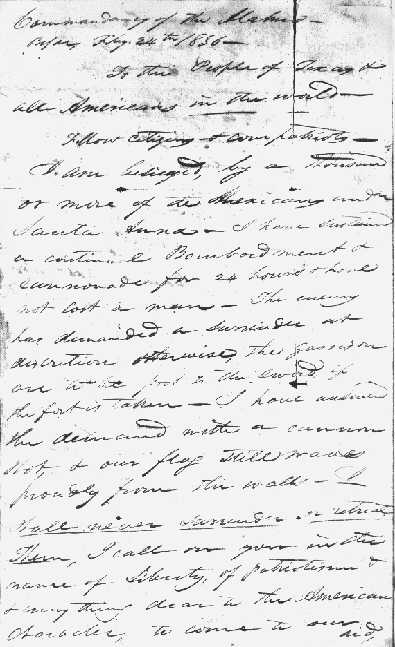
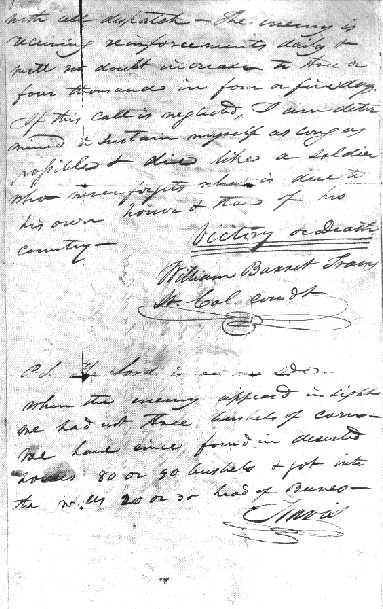
 This is the letter that Colonel William B. Travis wrote as the  Mexican Army was growing in numbers by the day. This letter is
perhaps the most famous handwritten manuscript in the history of Texas. facing certain death, Travis and his men held the Alamo for another eleven days, thus allowing troops in other parts of Texas to organize and ready themselves to fight for their God-given rights of Freedom and Liberty.


The siege of the Alamo entered its second day on February 24, 1836. James Bowie had fallen ill and confined himself to a room on the south side of the Alamo, leaving full command of the mission to Colonel William B. Travis. Seeing the enemy's 5000 troops against less than 200 of his own men, Travis sent out a desparate plea for reenforcements. His letter became one of the most famous manuscripts in the history of our country.

Colonel Travis wrote:


Commandancy of the Alamo
Bexar, Fby. 24th, 1836


To the People of Texas &
all Americans in the world
Fellow Citizens & Compatriots

I am besieged by a thousand
or more of the Mexicans under
Santa Anna. I have sustained a
continual bombardment &
cannonade for 24 hours & have
not lost a man. The enemy
has demanded a surrender at
discretion, otherwise the garrison
are to be put to the sword if
the fort is taken. I have answered
the demand with a cannon
shot, and our flag still waves
proudly from the walls. I
shall never surrender nor retreat.

Then, I call on you in the
name of Liberty, of patriotism, &
of everything dear to the American
character, to come to our aid 

with all dispatch. The enemy is
receiving reinforcements daily &
will no doubt increase to three or
four thousand in four or five days.
If this call is neglected, I am deter-
mined to sustain myself as long as
possible & die like a soldier
who never forgets what is due to
his own honor & that of his
country.
Victory or Death
William Barret Travis
Lt. Col. Comdt.

P. S. The Lord is on our side.
When the enemy appeared in sight
we had not three bushels of corn.
We have since found in deserted
houses 80 or 90 bushels & got into
the walls 20 or 30 head of Beeves.

Travis

(Colonel Travis' letter copied from here)

Once again we quote from Wikipedia as they detail further goings on on February 24, 1836, "Travis sent the letter with courier Albert Martin, who delivered it to Gonzales.[48] There, Launcelot Smithers took custody of the message and delivered it to San Felipe,[49] where it was read by Governor Henry Smith. Smith told the colonists at San Felipe "to fly to the aid of your besieged countrymen and not permit them to be massacred by a mercenary foe. ... The call is upon ALL who are able to bear army, to rally without one moment's delay, or in fifteen days the heart of Texas will be the seat of war."[50] The letter was eventually reprinted throughout the United States and much of Europe.[44]
In early evening Mexican Colonel Juan Bringas led scouts across a footbridge over the San Antonio River; Texian sharpshooters quickly killed one soldier and the Mexicans retreated, but Davy Crockett managed to drop a second man before the enemy finally reached cover.[44] Throughout the night the Mexican artillery sporadically bombarded the church and long barracks, while the Mexican army fired muskets and shouted to fool the Texians into believing that an assault was imminent, or that Texian reinforcements were being slaughtered.[51] Santa Anna also ordered that his military band serenade the Texians throughout the night. Mexican soldiers took advantage of the darkness and the distractions of the countrymen to erect two more artillery batteries around the Alamo.[44] The two batteries combined to hold two 8-lb cannon, two 6-lb cannon, two 4-lb cannon, and two 7-in howitzers. One of the batteries was located along the right bank of the San Antonio River, approximately 1,000 feet (300 m) from the south wall of the Alamo. The other was located 1,000 feet (300 m) east of the eastern wall.[52] By the end of the first full day of siege the Mexican army had been reinforced by 600 of Sesma's troops.[53] Gaona and the First Brigade were still several days march away, while an additional 400–500 men and most of the Mexican artillery were struggling through mud south of Bexar."


 Reading Colonel Travis' letter and knowing the strength of the Mexican Army was growing by the day, one can almost sense the desperation of the moment. Yet Travis and his men remained defiant in the face of the astronomical odds against them. For these brave souls, staring Death in the face every moment of every day must have been like living in Hell. However, these men knew that the cause they were willing to die for was much bigger than themselves. They would not die in vain. They died for Freedom and Liberty. They died for Texas, God rest their souls and God bless Texas.

Wednesday, February 23, 2011

The Battle of the Alamo

The Shrine of Texas Liberty
February 23, 1836 is one of the most important dates in the annals of Texas History. It was on this date 175 years ago that one of the most famous battles ever fought on any land got underway. The Battle of the Alamo had begun. Today, as we recount the events of Febrary 23, 1836, I will forego my usual commentary and allow those who are far more qualified than I to retell the story of the defining moment in Texas History.

We begin with this from Wikipedia : "In the early hours of February 23, residents began fleeing Béxar, fearing the Mexican army's imminent arrival. Although unconvinced by the reports, Travis stationed a soldier in the San Fernando church bell tower—the highest location in town—to watch for signs of an approaching force.[22] Travis then sent Captain Philip Dimitt and Lieutenant Benjamin Noble to scout for the Mexican Army's location.[24] At approximately 2:30 that afternoon[24] the church bell began to ring; the soldier stationed in the tower claimed to have seen flashes in the distance.[22] Dimitt and Noble had not returned, so Travis sent Dr. James Sutherland[Note 3] and John W. Smith on horseback to scout the area.[22][24] Smith and Sutherland spotted members of the Mexican cavalry within 1.5 miles (2.4 km) of the town and returned to Béxar at a run."
Wikipedia continues with the story.

Thealamo.org sums it up very nicely with these words:"People worldwide continue to remember the Alamo as a heroic struggle against impossible odds — a place where men made the ultimate sacrifice for freedom. For this reason, the Alamo remains hallowed ground and the Shrine of Texas Liberty."

I can add only six words to all that you've read in this post. Remember the Alamo! God bless Texas!

Tuesday, February 22, 2011

Texas Tidbits: Juan Seguin - Man of Courage

A Hero in Any Language
It's very easy to get caught up in the history of the Texas Revolution and just do the easy thing and write about such Texas heroes as Jim Bowie, Davy Crockett and Sam Houston. Today, I am going to recognize heroes of the Revolution that were actually born in Texas, specifically Texas-born Mexicans. After all, Texas was still a state of Mexico as the Revolution  raged on. This was, after all, their home and they were sending their fathers, sons and brothers into battle also, and many of these men were as much a hero as any man who fought at the Alamo. Texas was their home and, like the more famous names in Texas History, Freedom and Liberty were these men's dreams.

One of the more notable Texas-born Mexican of the Texas Revolution was Juan Seguin. Seguin's is a very interesting story. We begin the story of Juan Seguin as he had just arrived at the Alamo with a band of Texas-born Mexicans to assist Colonel Travis in defend the mission. his stay would be a short one, "Captain Juan N. Seguin, son of Don Erasmo Seguin, organized a company of Texas-born Mexicans to aid in the defense of the Alamo. The native population of San Antonio repeatedly warned Col. Travis to retreat, warning him that he was certain to be overwhelmed, but evidently his hope of receiving aid from other sources caused him to remain. Seguin's men not only assisted in the storming of Bexar, in the preceding December, but some were then serving as scouts for Houston's army at González. Seven of this company fell at the Alamo; namely: Juan Abanillo, Gregorio Esparza, Antonio Fuentes, Toribio Losoya, Andres Nava and Juan Antonio Padilla, all natives of San Antonio, and José Maria Guerrero called "El Tuerto," from Laredo....." Please continue to read about Juan Seguin's service to Texas during the Revolution here at the library at Texas A&M. It's an amazing look at a man who played a pivotal part in the Texan victory over General Santa Anna.

I salute the brave men of Mexican ancestry whose dream of being free men and their willingness to fight and, in many cases, die for Texas' Independence is a legacy not forgotten by the people of Texas nearly 200 years later. I offer to these men a simple prayer...Vayan con Dios, mis amigos. Vayan con Dios. En el Nombre del Padre, el hijo y el Espirito Santo. Amen.

Monday, February 21, 2011

Texas Tidbits: Susanna Dickinson, Alamo Survivor

Oh, Susanna!
For the last couple of weeks, we have been learning about the men during the siege of the Alamo, including a freed slave named Joe. At least two more people survived the onslaught of the Mexican Army during those thirteen days in Febrauary and March of 1836 - Susanna Dickinson and infant daughter, Angelina. Mrs. Dickinson was set free when she refused an offer by General Santa Anna himself to adopt Angelina and have her educated in Mexico. Upon that refusal, Susanna was given $2 and told to go forth and spread the word of the power of the Mexican Army and to tell pthers that any attempt to resist the Mexican Army would be futile. She told others what Santa Anna wanted her to. One of those she told was Sam Houston. We know what happened a few weeks later.

According to Wikipedia;
Susanna Dickinson reported, after the battle, the following had occurred during the siege and ultimate fight;
  • There were very few casualties before the final assault. She did not know the number.
  • She confirms that the legendary "line in the sand" incident, where Col. William Travis gave the defenders the choice of staying or leaving, did happen. However, she reports that it happened the day before the final assault, when it is believed to have happened on either March 3 or March 4.
  • On the morning of the assault, her husband ran in to where she'd hidden, made his final statements to her and revealing that the Mexicans were inside, then returned to his duty. She never saw him again, nor did she ever see his body.
  • She hid inside the chapel, and did not see the actual battle. One defender ran inside during the battle, attempting to hide, but was killed by Mexican soldiers.
  • When she was discovered, a Mexican officer intervened, with her saying she believed he was a British mercenary named either Black or Almonte. She was mistaken about his ethnicity, as he was Col. Juan Nepomuceno Almonte, who spoke perfect English, having been educated in New Orleans, Louisiana.
  • Outside there was a single survivor, found hiding, who unsuccessfully begged for mercy and was killed. Joe also reported this, claiming the man's name was Warner. However no Warner is listed as being at the Alamo. The closest name in similarity to Warner is Henry Warnell, however Warnell departed the Alamo as a courier on February 28, 1836.
  • She saw the body of Davy Crockett between the chapel and the barracks building.
  • She saw the body of Jim Bowie with two dead Mexican soldiers lying beside him.
  • She was taken to a house where she'd previously lived, and from there could see the pyres of the dead being burned.
  • The next day she was taken before Santa Anna, and Almonte, or Black, convinced Santa Anna to release her rather than imprison her.
  • At some point after the battle, she has no recollections, only that she wept for days.
Some points of Dickinson's account were confirmed by other survivors, including Enrique Esparza, the son of Alamo defender Gregorio Esparza. Joe confirmed other statements. End of Wiki info.

What a story Susanna Dickinson had to tell. You can read more on her Wikipedia page. I wish I had more time and space to dedicate to Mrs. Dickinson's incredible story. Perhaps we can re-visit this story again in the future. It really fascinates me with what the few survivors of the Battle of the Alamo had to say about what they saw and heard during those historic thirteen days in 1836.

God bless Susanna Dickinson and may God continue to bless Texas.

Sunday, February 20, 2011

Texas History - The Week in Review

We have had a very interesting week in traveling back and time to observe Texas History almost as if we were right along side some of the eyewitnesses to the events of the Texas Revolution. Your response to the posts of the past week has been amazing. I want to thank all of you from literally all over the world for taking time to visit the site and learning or re-learning, as the case may be, the History of that grand place we call Texas.

If you didn't get a chance to read one or all of the posts for the last week, I'll list them below for you and you can play catch up in order to be ready for more of the history of the Lone Star State.

Texas History: The Week in Review
That ought to keep you busy for a while. I uncovered some really cool stuff this week about some ordinary people who transformed themselves into heroes whose names and memories will live forever. They fought for Freedom and Liberty and had no real chance to win either. But they won the war and in the process created an independent nation that survived much like the men who died for it - with courage, bravery and the will to overcome great odds. Men truly forged of a hotter fire. Men known all over the world by a single common bond. Men known as Texans. God blessed Texas with these men and may He continue to bless her today.

Saturday, February 19, 2011

Texas Tidbits: A Texas Hero from Germany

The Texas Revolution drew men from all over the United States in support of the Texians and their fight for freedom. Some of these men were recent immigrants from locations all over the world. One such man was Dr. Gustavus Bunsen of Frankfurt, Germany. Gustavus came from a well to do, educated family and he was no stranger to war. He had participated in wars in Poland and Germany before coming to the United States, so the Texas Revolution seemed like a natural fit to him.

Gustavus settled for a short time in Cincinnati where he joined the Louisville Volunteers in October, 1835 then he was bound for Texas where he was soon to die at the hands of Mexican Troops.An unpleasant task resulted in someone having to tell the soldier's family of his death and then settling the soldier's estate. In the case of Dr. Bunsen, this duty fell to William Longerheim. Below is a copied and pasted PDF describing the battle in which Dr. Bunsen died, the circumstances of his death and more. It's a bit of a read, but it's well worth your time to "be there" on that day in 1836.

Affidavit of William Longenheim concerning the death

Of Dr Gustavus Bunsen

William Longenheim being duly sworn stateth as follows:

I am a native of Germany, citizen of the Republic of Texas

And reside at this city at present.  In the year 1836 while I

was serving as orderly Sergeant in Capt. P. Thomas Pear-

         st
-sons 1   Artillery Company of the Texian Volunteer-

Army, Gustavus Bunsen M.D. a native of the Free City of

Frankfurt o/m in Germany joined the said Company, while

encamped near the town of Goliad or La Bahia in Texas.

Towards the end of the month of February 1836 this company

was together with the Company of Capt. Llewellyn under-

-command of Colonels Johnson and Charles Grant employed

in bringing horses for the use of the Texian Army from the

State of Tamaulipas into Texas.         Shortly after this party

arrived on the north bank of the river Nueces I was detached

by order of Cols. Johnson and Grant to take in charge the horses

we had collected and guard them at the farm of Don Manuel

a mexican proprietor about two miles south of the town of

the irish settlement at San Patricio in Texas.         Amongst the

12 men I had to select to guard the horses was my friend the

                                                        th
above named Dr Gustavus Bunsen.             On the 27   of February

the party under my charge was surprised and attacked by the

advanced guard of the right division of the mexican army

then about invading Texas under command of General Urrea.

In the first moment of the attack Dr G. Bunsen, then very

close to me, was wounded b y bullets in the head and in the

breast as I clearly perceived and fell down apparently dead.

Myself and three of my comrades were taken prisoners, the

rest of them were killed on the spot or severely wounded.


After some days the eldest son of the owner of the farm, having

obtained admission to the prison, where we were kept, related

to me the fate of my wounded comrades.           Dr Bunsen, with

whom he became acquanted during our encampment at his

                                                              fathers

[Begin page two]

fathers farm, he said, died of his wounds the same he was

wounded at his fathers house and was burried at the burrial

place of his family in the garden adjoining the house.          In

the early part of the month of May, while I was kept as

prisoner the war in the prison of Matamoros I met the owner

of the farm, who confirmed the statement of this son in every

particular as well in respect of the wounds as the death and

burial of the said Dr Gustavus Bunsen.  About the same time

John Spiess a native of Aargan in Switzerland, who had be-

longed to the party under my charge and being shot through

the hip in the conflict was not kept with the rest of the

prisoners having gained admittance to the prison at Matamo-

ros stated to me in presence of my companions, that the

said Dr Bunsen after being wounded very severely in the

attack, died the same afternoon in the same room where he,

the said john spiess, lay wounded nd that his body was

buried the following day.

         I know the above designated owner of the farm and his son

as an upright, religious and well behaved men and the said

John Spiess, who had been in company with Dr Bunsen since

he left the town of Louisville in the state of Kentucky, as an

honest, well meaning and veracious man.           I therefore have


no doubt that the statement as above related is true and

that Dr Gustavus Bunsen is actually dead.

Phineas Jencks Mahan and George Copeland natives of

Philadelphia and now residing near the city of Houston

in Texas were taken prisoners in the above narration engage-

-ment and will, I have no doubt, confirm the facts of this

statement.

                             William Longenheim

Sworn and subscribed ∫

before me one of the         ∫

Aldermen of the City  ∫

of Philadelphia             ∫

Jany 5. 1841                ∫

          O. Christian      ∫

This PDF was copied and pasted from the Handbook of Texas Online

God bless men like Dr. Gustavus Bunsen and may God continue to bless Texas.

Copyright ©

All Original Material © Toby Shoemaker